
India’s electric vehicle market is entering a more difficult phase. The easy growth period driven by subsidies, first-time adopters, and investor enthusiasm is fading. In its place comes a more demanding environment shaped by profitability pressures, operational discipline, customer trust, and manufacturing consistency.
Few companies illustrate that transition more sharply than Ola Electric.
Once celebrated as the company that could redefine India’s two-wheeler industry, Ola Electric now faces increasing scrutiny over whether it can transform aggressive expansion into a sustainable business. While the company still remains one of India’s largest electric scooter makers, recent quarters have exposed deeper concerns around slowing deliveries, widening losses, service quality, execution consistency, and investor confidence.
The broader question confronting the company is no longer whether India will adopt electric two-wheelers. That trend is already underway. The question is whether Ola Electric can maintain leadership while simultaneously fixing its economics and operational foundations.
From EV Market Leader to a Company Under Pressure
Founded by Bhavish Aggarwal, Ola Electric positioned itself as India’s answer to Tesla-style disruption in mobility. The company scaled rapidly through direct-to-consumer distribution, aggressive pricing, vertically integrated manufacturing ambitions, and high-volume production targets.
For a period, that strategy worked.
Ola became one of the most visible names in India’s EV ecosystem, benefiting from government incentives, rising fuel prices, and growing consumer interest in electric mobility. Its Futurefactory in Tamil Nadu symbolized India’s manufacturing ambitions in the EV sector.
But scaling quickly also exposed structural weaknesses.
Over the last two years, Ola Electric has faced repeated complaints around after-sales service, delivery delays, software glitches, spare-parts shortages, and inconsistent customer experience. Simultaneously, established automotive companies such as TVS Motor Company and Bajaj Auto expanded aggressively into electric scooters with stronger dealership networks and more mature operational systems.
That shift has intensified competitive pressure at a time when Ola itself is attempting to reduce losses and stabilize margins.
The Profitability Problem Has Become Harder to Ignore
Ola Electric’s recent financial results have sharpened investor concerns around the sustainability of its business model.
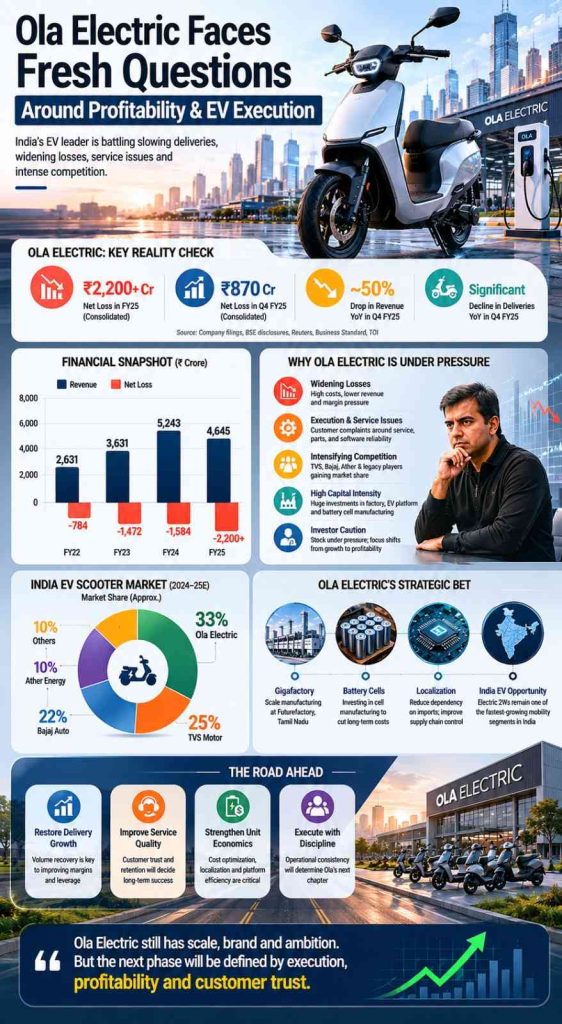
The company reported widening losses in FY25 even as revenue growth weakened and deliveries slowed materially. According to recent quarterly disclosures, consolidated net losses for FY25 expanded to over ₹2,200 crore while revenue declined compared to the previous fiscal year.
Quarterly performance has remained volatile.
In Q4 FY25, Ola Electric reported a consolidated net loss of around ₹870 crore, while revenue from operations fell sharply year-on-year. Deliveries also declined significantly, reflecting weaker demand momentum and competitive pressures in the premium electric scooter segment.
Management has argued that cost rationalization initiatives and platform efficiencies will eventually improve margins. The company has repeatedly emphasized efforts to lower operating costs, localize battery production, and optimize manufacturing.
However, analysts tracking India’s EV market increasingly believe the challenge is not simply reducing costs. It is achieving profitable scale in a market where pricing pressure is intensifying and consumers are becoming more quality-sensitive.
Unlike software startups, EV manufacturers must balance manufacturing efficiency, supply chain reliability, warranty costs, service infrastructure, inventory management, and capital-intensive expansion simultaneously.
That complexity has become increasingly visible in Ola Electric’s numbers.
Service and Execution Concerns Continue to Hurt Brand Perception
One of the biggest risks facing Ola Electric is reputational rather than technological.
The company’s early growth strategy prioritized rapid scale and market capture. But execution gaps — especially around customer support and after-sales service — have repeatedly surfaced in public complaints and consumer discussions.
Online forums and customer communities have documented recurring frustrations related to repair timelines, software bugs, replacement parts, and service center responsiveness. While anecdotal discussions should not be treated as definitive evidence, the consistency of such complaints over time has contributed to broader concerns around operational maturity.
In consumer mobility businesses, trust compounds slowly but erodes quickly.
Traditional automakers such as Hero MotoCorp, TVS, and Bajaj benefit from decades of service infrastructure and customer familiarity. Ola Electric, by contrast, attempted to build a nationwide EV ecosystem at startup speed.
That strategy helped accelerate adoption but also increased operational strain.
The company has since expanded service networks and announced initiatives aimed at improving customer support. Yet investors and consumers alike are now watching whether those improvements translate into measurable long-term satisfaction rather than temporary recovery efforts.
Competition Is No Longer Theoretical
Ola Electric’s early advantage came partly from being ahead of legacy manufacturers in India’s electric scooter transition.
That advantage has narrowed.
Companies including TVS, Bajaj, and Ather Energy have strengthened product portfolios, improved distribution reach, and gained market share in India’s rapidly evolving electric two-wheeler segment.
Unlike startup-led EV companies, incumbent automakers already possess dealer ecosystems, vendor relationships, financing partnerships, and operational experience built over decades.
This changes the economics of competition.
Ola Electric must now compete not only on innovation and pricing, but also on reliability, service quality, resale confidence, and execution consistency. That is a harder battle than early market creation.
The company’s premium segment weakness during recent quarters reflects this changing market structure.
The Gigafactory Bet Could Define Ola’s Future
Despite operational pressures, Ola Electric continues to push aggressively into vertical integration.
The company recently approved significant investments into EV and battery cell manufacturing units as it attempts to localize battery production and reduce long-term costs.
Strategically, this makes sense.
Battery costs remain one of the most important variables determining EV profitability. Companies that can improve cell economics and supply chain control may eventually gain meaningful margin advantages.
But the strategy also increases capital intensity and execution risk.
Building battery manufacturing capabilities requires deep expertise, stable production yields, large-scale procurement systems, and long-term financing discipline. Globally, even some of the largest EV manufacturers have struggled to scale battery operations efficiently.
For Ola Electric, the challenge is especially delicate because the company is attempting to improve profitability while simultaneously expanding manufacturing ambitions.
That creates tension between growth investments and financial sustainability.
Investor Confidence Has Become More Fragile
Public markets are increasingly less tolerant of growth narratives unsupported by profitability visibility.
Following its IPO phase and early optimism, Ola Electric’s stock performance has reflected growing investor caution around execution timelines, margin recovery, and market share sustainability. Reuters previously reported that the company revised revenue expectations downward while continuing to pursue aggressive cost optimization measures.
The company has also undertaken restructuring initiatives, including workforce reductions, as part of its profitability push.
For investors, the key question is whether Ola Electric is entering a stabilization phase or whether operational volatility remains structural.
The answer likely depends on three variables:
1. Can Ola Restore Consistent Delivery Growth?
Volume recovery remains critical for improving manufacturing leverage and fixed-cost absorption.
2. Can Service Quality Improve Meaningfully?
Customer retention and brand trust will determine long-term competitiveness.
3. Can Battery Localization Actually Improve Margins?
Vertical integration only works if operational execution matches capital deployment.
India’s EV Market Still Has Long-Term Potential
Despite the scrutiny surrounding Ola Electric, India’s EV opportunity remains substantial.
Electric two-wheelers are expected to remain one of the fastest-growing mobility categories in the country due to urban commuting patterns, fuel economics, and regulatory support.
However, the industry itself is entering a more disciplined phase.
Investors are increasingly rewarding companies that demonstrate operational resilience rather than pure growth narratives. In this environment, manufacturing discipline, service infrastructure, and capital efficiency matter as much as product innovation.
That shift affects not just Ola Electric, but the broader Indian startup ecosystem as well.
For years, many technology-led startups prioritized rapid scale under the assumption that profitability could come later. In hardware-intensive sectors such as electric vehicles, that assumption is proving harder to sustain.
The Road Ahead for Ola Electric
Ola Electric still possesses meaningful advantages.
The company has strong brand recall, manufacturing scale, consumer visibility, and a prominent position in India’s EV transition story. It also continues to invest heavily in localization and platform development.
But the company’s next phase will likely be defined less by ambition and more by operational consistency.
Execution — not storytelling — is now the central challenge.
If Ola Electric can stabilize service quality, improve margins, and execute its manufacturing strategy efficiently, it could still emerge as one of India’s defining EV companies.
If not, it risks becoming a cautionary example of how aggressive scaling without operational maturity can undermine even the strongest market opportunities.
The coming few quarters may therefore matter more than any previous phase in the company’s journey.
Also Read : Jason Kothari’s Mythik Raises $5 Million to Scale AI-Driven Global Entertainment Ambitions
Add Startup Magazine as a preferred source on Google-Click Here
Last Updated on Thursday, May 21, 2026 2:42 pm by Startup Magazine Team
About The Author
