
India’s flexible workspace industry is entering a new phase of maturity — and Awfis Space Solutions appears to be among the clearest beneficiaries of that shift.
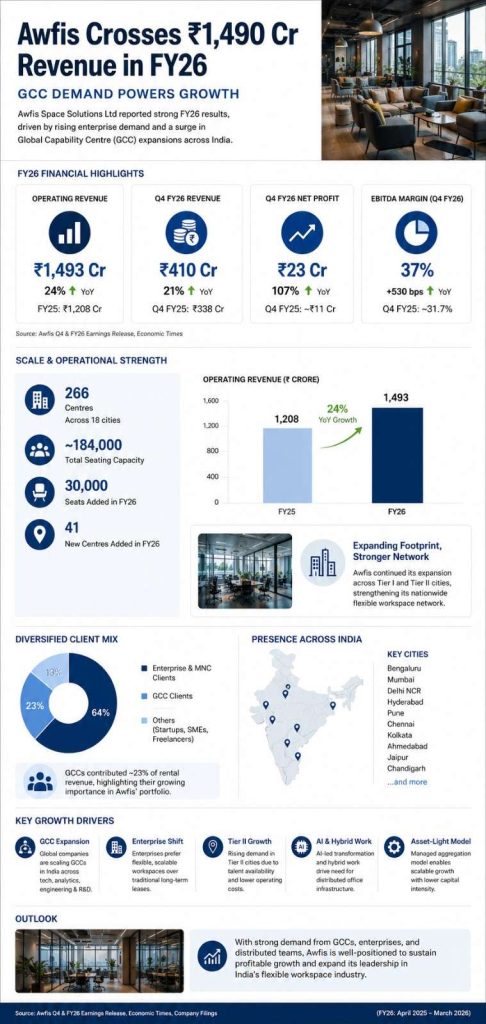
The publicly listed coworking and managed office provider reported FY26 operating revenue of approximately ₹1,493 crore, marking a 24% year-on-year increase from ₹1,208 crore in FY25. The growth was driven largely by sustained demand from enterprises and Global Capability Centres (GCCs), which are increasingly reshaping India’s commercial real estate market.
The company also reported quarterly revenue of ₹410 crore in Q4 FY26, up nearly 21% year-on-year, while net profit more than doubled to about ₹23 crore during the quarter.
The results underline a broader structural trend: flexible workspaces are no longer viewed as temporary overflow solutions for startups. Increasingly, they are becoming core infrastructure for multinational corporations, technology firms, and GCC operators seeking speed, flexibility, and lower capital expenditure.
The GCC Wave Is Reshaping India’s Office Market
The strongest signal from Awfis’ FY26 performance was the expanding contribution of GCC clients.
According to company disclosures and industry reports, Awfis now serves more than 100 GCC clients, with GCCs contributing roughly 23% of its rental revenue. Enterprise and multinational clients together account for nearly 64% of the company’s clientele.
That matters because India’s GCC ecosystem is undergoing rapid expansion.
Over the last few years, global companies across sectors — including banking, healthcare, software, retail, and engineering — have accelerated investments in India-based capability centres. These centres are no longer limited to back-office operations; many now handle AI engineering, product development, cybersecurity, data analytics, and R&D functions.
Flexible workspace operators have emerged as critical enablers of this expansion cycle.
Instead of committing to large long-term office leases upfront, GCCs increasingly prefer managed workspace providers that can offer:
- Faster office deployment
- Flexible seat expansion
- Lower upfront capex
- Plug-and-play infrastructure
- Multi-city scalability
For operators like Awfis, this shift improves revenue visibility and occupancy stability compared to earlier dependence on startups or freelancers.
From Startup Coworking to Enterprise Infrastructure
India’s coworking industry has evolved significantly since the pre-pandemic years.
The first phase of the sector was driven primarily by startups, freelancers, and small businesses looking for lower-cost office alternatives. But the pandemic fundamentally altered enterprise attitudes toward workplace strategy.
Large companies now increasingly operate hybrid workforce models, distributed teams, satellite offices, and flexible occupancy plans. This has expanded the addressable market for managed workspace providers.
Awfis’ numbers reflect that transition.
Coworking and allied services contributed more than 83% of the company’s operating revenue in Q4 FY26, growing nearly 27% year-on-year to ₹341.5 crore. The company’s fit-out and construction business added another ₹68.6 crore during the quarter.
The company also expanded aggressively during FY26:
- 41 new centres added
- 30,000 operational seats added
- Presence expanded to 266 centres
- Total seating capacity reached approximately 184,000 seats
- Operations across 18 Indian cities including Tier I and Tier II markets
This expansion strategy mirrors a wider industry move toward distributed office infrastructure beyond Bengaluru, Mumbai, Delhi NCR, and Hyderabad.
Tier II Cities Are Becoming Strategic Growth Markets
One of the more important developments in India’s flexible workspace sector is the growing relevance of Tier II cities.
Companies are increasingly exploring cities such as Jaipur, Chandigarh, Kochi, Indore, Bhubaneswar, Coimbatore, and Ahmedabad for talent access and lower operating costs.
Coworking firms see this as an opportunity to capture early enterprise demand before traditional commercial real estate supply fully matures in these regions.
Awfis has steadily expanded outside major metros over the past few years. The company previously indicated that Tier II markets were becoming an important component of its portfolio strategy.
Industry analysts note that this shift could structurally benefit managed workspace providers because enterprise clients entering smaller cities often prefer outsourced office management instead of directly handling leases, design, and operations.
Profitability Signals Matter More Than Growth Alone
The Indian coworking sector historically faced investor skepticism around profitability, occupancy sustainability, and capital intensity.
Many operators prioritized aggressive expansion before establishing predictable cash flows. As a result, public market investors increasingly evaluate workspace companies on operational leverage rather than just footprint growth.
Awfis’ FY26 results suggest improving operating discipline.
The company reported:
- Operating EBITDA growth of roughly 31% in Q4 FY26
- EBITDA margins expanding to nearly 37%
- Quarterly net profit doubling year-on-year
Its expansion strategy has also relied heavily on a managed aggregation model rather than fully owned assets. This allows the company to scale capacity while limiting direct real estate ownership risk.
That model becomes especially important in volatile commercial real estate cycles where occupancy fluctuations can pressure balance sheets.
India’s Flexible Workspace Market Is Entering Consolidation
The broader flexible workspace industry in India is becoming more institutionalized.
Over the last two years, the sector has seen:
- Public market listings
- Enterprise-focused consolidation
- Rising institutional investor interest
- Increased landlord partnerships
- Stronger compliance and governance expectations
The market is also moving beyond traditional coworking.
Workspace operators are increasingly positioning themselves as integrated workplace solution providers offering:
- Managed offices
- Build-to-suit infrastructure
- Design and fit-out services
- Hybrid workspace management
- Enterprise facility operations
Awfis’ growing construction and fit-out segment reflects this diversification strategy.
AI, Hybrid Work, and the Future of Workspace Demand
Another emerging factor influencing the sector is the rise of AI-led operational transformation.
Many companies are redesigning office utilization models as AI automation changes workforce structures and collaboration patterns. At the same time, hybrid work remains deeply embedded in enterprise planning.
This creates an unusual dynamic:
Companies may reduce fixed headquarters expansion but still require distributed collaborative office infrastructure.
That trend could continue benefiting flexible workspace providers that can offer scalable, technology-enabled office networks.
Awfis has also highlighted technology integration and AI-led operational efficiencies as part of its expansion strategy.
However, risks remain.
The sector is still exposed to:
- Commercial real estate cycles
- Occupancy volatility
- Economic slowdowns
- Enterprise spending cuts
- Competitive pricing pressure
Additionally, the long-term sustainability of rapid expansion models will depend on occupancy quality rather than raw seat additions alone.
Investor Sentiment Reflects Growing Confidence
Following the Q4 FY26 results announcement, Awfis shares rose sharply in trading, reflecting investor optimism around profitability improvement and sustained enterprise demand.
Public market investors appear increasingly willing to differentiate between flexible workspace companies with:
- Strong enterprise exposure
- Predictable recurring revenue
- Capital-efficient scaling
- Operational profitability
That marks a notable shift from earlier perceptions of coworking businesses as speculative real estate-adjacent startups.
The Bigger Picture
Awfis’ FY26 performance reflects more than company-specific execution. It signals a broader transformation in how India’s office infrastructure market is evolving.
Flexible workspaces are gradually becoming embedded into enterprise real estate strategy rather than operating on the periphery of commercial leasing.
The rise of GCCs, distributed workforces, and hybrid operating models is creating long-term demand for flexible office infrastructure that can scale quickly across cities.
For India’s coworking sector, the challenge ahead will not simply be expansion — it will be sustaining profitability while competing in an increasingly crowded and institutionalized market.
Awfis’ FY26 numbers suggest the company is currently positioned on the favorable side of that transition.
Also Read : Why Consumer Tech Startups in India Are Facing a Trust Deficit
Add Startup Magazine as a preferred source on Google-Click Here
Last Updated on Tuesday, May 26, 2026 11:25 am by Startup Magazine Team
About The Author
