
The race to build the future of software development is accelerating—and investors are willing to pay a premium for companies they believe can redefine how code gets written.
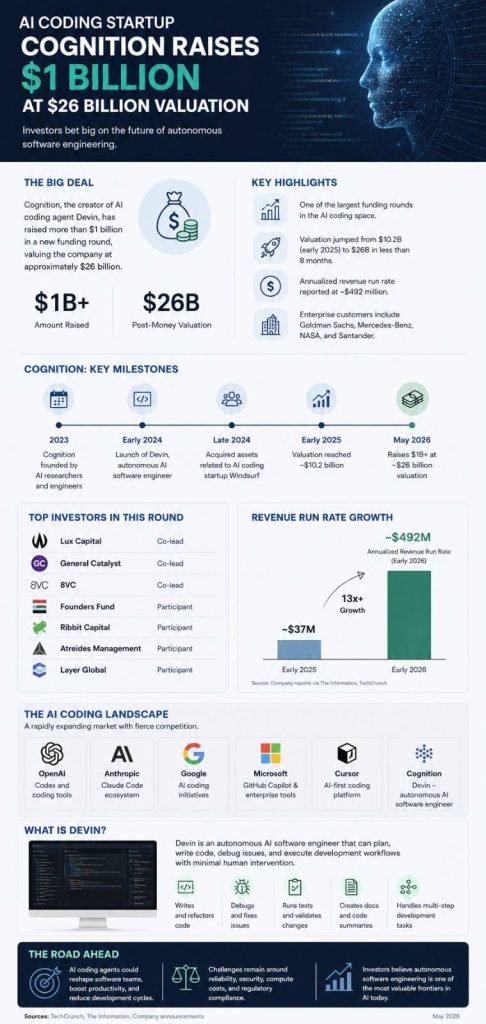
Cognition, the artificial intelligence startup behind autonomous coding agent Devin, has raised more than $1 billion in a new funding round that values the company at approximately $26 billion. The deal represents one of the largest funding rounds in the emerging AI coding sector and underscores growing investor conviction that software engineering may become one of the first knowledge-work functions to undergo large-scale AI automation.
The financing comes less than a year after Cognition achieved a valuation of roughly $10.2 billion, highlighting the extraordinary pace at which capital continues to flow into AI infrastructure, developer tools, and agent-based software platforms.
A Major Vote of Confidence in AI Software Engineering
According to company announcements and investor disclosures, the round was co-led by venture firms Lux Capital, General Catalyst, and 8VC, with participation from existing and new investors including Founders Fund, Ribbit Capital, Atreides Management, and Layer Global.
The funding arrives at a time when AI-powered coding tools have become one of the fastest-growing segments in enterprise software.
Unlike conventional coding assistants that primarily generate snippets or autocomplete suggestions, Cognition’s flagship product Devin is positioned as an autonomous software engineer capable of planning tasks, writing code, debugging issues, and executing development workflows with limited human intervention. The company has consistently framed Devin as an AI teammate rather than a simple productivity tool.
That distinction is increasingly important as the industry shifts from AI copilots toward AI agents capable of executing multi-step tasks independently.
From Research Project to One of AI’s Most Valuable Startups
Founded in 2023 by former competitive programmers and AI researchers, Cognition quickly emerged as one of Silicon Valley’s most closely watched AI startups after publicly unveiling Devin in early 2024.
The company’s growth trajectory has been unusually steep even by AI-era standards.
Cognition’s valuation has climbed from approximately $10.2 billion following its 2025 funding round to $26 billion in less than eight months, making it one of the fastest valuation increases among venture-backed AI companies.
The company has also expanded beyond startup customers and developer enthusiasts. Reports indicate that enterprise clients include organizations such as Goldman Sachs, Mercedes-Benz, NASA, and Santander, suggesting that large enterprises are increasingly willing to experiment with autonomous coding systems in production environments.
While independent verification of deployment depth remains limited, the customer roster illustrates the level of enterprise interest surrounding AI-powered software development.
The Revenue Numbers Drawing Investor Attention
One reason investors appear willing to support such aggressive valuations is Cognition’s reported revenue growth.
Multiple reports indicate that the company has reached an annualized revenue run rate of roughly $492 million, up significantly from approximately $37 million a year earlier.
If those figures accurately reflect sustained enterprise adoption, they would place Cognition among the fastest-growing software companies in recent startup history.
However, it is important to distinguish annualized revenue run rate from recognized annual revenue. Run-rate figures extrapolate current performance and may not necessarily translate into long-term recurring revenue. Investors often view them as growth indicators rather than definitive measures of business maturity.
Even with that caveat, the reported numbers help explain why venture capital firms continue to place substantial bets on AI coding startups despite increasingly competitive market conditions.
The AI Coding Market Is Becoming Crowded
Cognition’s latest funding round comes amid an increasingly intense battle for developer attention.
Over the past two years, nearly every major AI company has introduced products targeting software engineering workflows.
Among the most prominent competitors are:
Model Providers Expanding Into Coding
- OpenAI’s Codex-related tools and coding capabilities
- Anthropic’s Claude Code ecosystem
- Google’s AI coding initiatives and agent-based development tools
- Microsoft GitHub Copilot and enterprise developer offerings
AI-Native Coding Companies
- Cursor
- Cognition
- Windsurf assets acquired by Cognition
- A growing ecosystem of agent-based developer startups
The competitive landscape has evolved rapidly. What initially appeared to be a market dominated by foundation model providers has increasingly become a contest between specialized application-layer companies and model developers themselves.
For investors, the key question is whether AI coding will ultimately be controlled by large model platforms or by specialized software companies building workflow-specific products on top of those models.
Cognition’s fundraising success suggests many investors still believe independent application-layer winners can emerge.
Beyond Code Generation: The Rise of AI Agents
The significance of Cognition’s funding extends beyond software development.
The company represents a broader shift toward “agentic AI”—systems designed not merely to generate content but to autonomously complete complex workflows.
In the AI industry’s first wave, products focused on generating text, images, and code snippets.
The second wave increasingly focuses on execution.
Developers are now experimenting with systems that can:
- Write and test software
- Manage repositories
- Debug production issues
- Conduct code reviews
- Generate documentation
- Coordinate development tasks
If successful, these systems could reshape software teams in much the same way automation transformed manufacturing and industrial operations.
That possibility is a major reason venture investors continue assigning premium valuations to companies operating in the category.
Why Valuations Continue to Climb
Cognition’s new valuation arrives during a period of extraordinary investor enthusiasm for AI companies.
Across the broader AI ecosystem, funding rounds have become progressively larger as investors compete for exposure to businesses perceived as foundational infrastructure providers for the next computing era.
Recent funding activity across the sector suggests that investors are prioritizing three characteristics:
- Strong enterprise adoption.
- Clear monetization pathways.
- Access to proprietary data, workflows, or user behavior.
Coding products satisfy all three requirements.
Software engineers represent a large, high-value user base. Development teams generate measurable productivity metrics. And coding workflows create substantial opportunities for AI automation.
As a result, coding remains one of the most commercially attractive AI categories today.
The Windsurf Acquisition and Strategic Expansion
Another factor contributing to investor confidence is Cognition’s expansion strategy.
The company previously acquired remaining assets associated with AI coding startup Windsurf after a highly publicized talent reshuffling involving larger technology companies. Industry observers viewed the move as a way for Cognition to deepen its position in the developer tooling ecosystem while acquiring product assets and customer relationships.
The acquisition highlighted a broader reality in today’s AI market: competition increasingly revolves around talent, infrastructure, and distribution rather than algorithms alone.
Companies that successfully combine all three are likely to maintain stronger competitive moats.
Risks Behind the Optimism
Despite strong investor enthusiasm, significant challenges remain.
Reliability Concerns
Autonomous coding systems continue to face questions around accuracy, security vulnerabilities, and hallucinations. Enterprise adoption will depend heavily on trust and governance frameworks.
Economic Sustainability
Many AI startups operate with substantial compute expenses. Long-term profitability remains uncertain for much of the sector.
Intensifying Competition
Large model providers possess significant advantages in infrastructure, capital access, and research talent. Independent AI application companies must prove they can maintain differentiated products over time.
Regulatory and Compliance Challenges
As AI-generated software becomes more common, enterprises may face new requirements around auditing, accountability, intellectual property, and cybersecurity.
These factors could influence how quickly autonomous coding platforms move from experimentation to widespread deployment.
What This Means for the Future of Software Development
The broader significance of Cognition’s latest funding round may be less about the company itself and more about what investors believe is happening to software engineering.
For decades, software development has remained one of the most labor-intensive knowledge professions. AI coding agents are beginning to challenge that assumption.
Rather than replacing developers outright, many industry observers expect AI systems to augment engineering teams, enabling smaller groups to build and maintain increasingly complex software systems.
In that future, developers may spend less time writing routine code and more time defining architectures, validating outputs, managing systems, and solving higher-order business problems.
Cognition’s $26 billion valuation reflects a belief that this transition is not a distant possibility but an emerging reality.
Whether that valuation ultimately proves justified will depend on how effectively autonomous AI agents move from impressive demonstrations to indispensable enterprise infrastructure.
For now, investors appear willing to make a billion-dollar bet that software engineering is entering a fundamentally new era.
Also Read : Awfis Crosses ₹1,490 Crore Revenue in FY26 as GCC Demand Powers Growth
Add Startup Magazine as a preferred source on Google-Click Here
Last Updated on Saturday, May 30, 2026 6:25 pm by Startup Magazine Team
About The Author
