
India’s defence technology ecosystem is entering a new phase—one increasingly defined not by drone assemblers alone, but by startups building the critical electronic infrastructure that powers modern unmanned systems.
Against this backdrop, drone avionics startup ZeroDrag has raised ₹6.5 crore in a seed funding round led by Transition VC, highlighting growing investor interest in companies developing indigenous technologies for strategic sectors. The funding arrives at a time when governments, defence agencies, and industrial customers are seeking alternatives to imported drone components, particularly amid rising geopolitical tensions and supply-chain vulnerabilities.
A Bet on the Electronics Layer of India’s Drone Industry
Founded in 2022 by Amit Nimje and Shantanu Bhede, ZeroDrag develops avionics and electronic sub-systems used in unmanned aerial vehicles (UAVs). Its portfolio includes autopilots, motor controllers, GNSS modules, telemetry systems, communication hardware, and payload integration solutions.
While much of the public conversation around drones focuses on aircraft platforms, avionics remain the intelligence layer responsible for navigation, communication, flight stability, and mission execution. Industry experts increasingly view this layer as one of the most strategically important parts of the UAV value chain.
The company says the fresh capital will be used to expand manufacturing capacity, strengthen research and development, improve testing and quality infrastructure, and accelerate the development of next-generation UAV electronics for domestic and international markets.
The funding follows an earlier pre-seed round of approximately ₹1.2 crore raised in 2023 from Enrission India Capital and angel investors.
Why Drone Electronics Have Become a Strategic Priority
The investment reflects a broader shift underway within India’s defence and aerospace sectors.
Over the past several years, drones have evolved from niche surveillance tools into essential assets for military reconnaissance, logistics support, border monitoring, precision agriculture, infrastructure inspection, and industrial operations. As adoption expands, attention is increasingly turning toward the supply chain behind these systems.
A significant portion of global drone electronics production remains concentrated in China. Industry stakeholders and policymakers have repeatedly highlighted the risks associated with overdependence on imported avionics, flight controllers, communication modules, and navigation systems.
This concern has intensified following geopolitical disruptions and export-control measures affecting advanced technologies worldwide. Investors are increasingly evaluating startups that can reduce dependence on foreign components while creating domestic manufacturing capabilities.
Transition VC, which led the round, positioned the investment within this broader strategic context, emphasizing the importance of sovereign technology capabilities in critical infrastructure sectors.
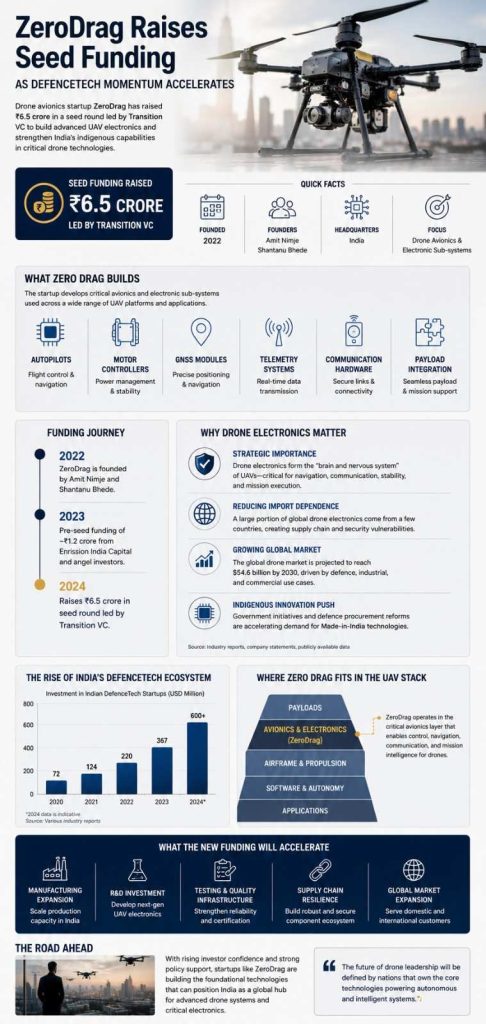
The Rise of India’s DefenceTech Investment Cycle
ZeroDrag’s funding comes amid a broader wave of capital flowing into defence and deep-tech startups.
Unlike previous startup cycles dominated by consumer internet and software-as-a-service businesses, recent years have seen increased investor attention toward sectors such as aerospace, semiconductors, robotics, advanced manufacturing, dual-use technologies, and defence systems.
Several factors are contributing to this shift:
Government Support for Indigenous Technologies
Initiatives such as Startup India, defence innovation programs, and various Ministry of Electronics and Information Technology-backed schemes have created more pathways for early-stage hardware startups. ZeroDrag itself has received support through Startup India, NIDHI, and government-linked innovation programs.
Defence Procurement Reforms
India’s defence procurement policies have increasingly encouraged domestic production and local sourcing, creating opportunities for startups that can provide critical components and subsystems.
Global Supply-Chain Realignment
Manufacturers in the United States and Europe are increasingly looking beyond China for drone components and avionics solutions. ZeroDrag has indicated growing interest from international markets seeking alternative suppliers.
Growing Availability of Early-Stage Capital
India’s early-stage investment ecosystem has matured considerably, with specialized micro-VCs and sector-focused funds emerging to back deep-tech and hardware ventures. While funding remains challenging for many founders, investor appetite for strategic technologies has increased compared with a decade ago. Discussions across startup communities and investor networks indicate stronger interest in deep-tech, aerospace, and defence-adjacent opportunities than in previous funding cycles.
Building Beyond Drone Assembly
One notable aspect of ZeroDrag’s business model is its focus on supplying components rather than building complete drones.
The company follows an OEM-agnostic approach, allowing its products to be integrated across multiple drone platforms and use cases. This strategy could potentially position the startup as a foundational supplier to a broader ecosystem of drone manufacturers.
Such an approach mirrors developments in other technology sectors, where long-term value often accrues not only to end-product manufacturers but also to companies building core infrastructure and enabling technologies.
In the drone industry, that infrastructure increasingly includes:
- Flight-control systems
- Navigation hardware
- Communication modules
- Sensor integration systems
- Electronic speed controllers
- Autonomy-focused hardware
As UAV deployments become more sophisticated, demand for reliable and locally manufactured electronics is expected to grow.
Challenges Ahead
Despite growing momentum, the road ahead for drone electronics startups remains complex.
Hardware businesses typically face longer development cycles, higher capital requirements, manufacturing challenges, certification hurdles, and supply-chain risks compared with software startups.
For defence-related applications, reliability standards are particularly stringent. Components often require extensive testing and validation before deployment in mission-critical environments.
Competition also remains intense. Global UAV electronics suppliers, particularly established Asian manufacturers, continue to benefit from scale, mature supply chains, and pricing advantages. ZeroDrag will need to demonstrate that indigenous manufacturing can compete on performance, reliability, and cost while maintaining technological differentiation.
Additionally, defence procurement cycles can be lengthy, requiring startups to balance long-term strategic opportunities with near-term commercial revenue generation.
What Comes Next for ZeroDrag
According to the company, the next 12 to 24 months will focus on expanding engineering capabilities, increasing production capacity, and broadening its product portfolio. Future development efforts may include enterprise-grade UAV hardware designed for heavy-lift drones and emerging electric vertical takeoff and landing (eVTOL) platforms.
The company’s trajectory will likely be watched closely by investors and policymakers interested in building domestic capabilities across the drone technology stack.
If successful, startups such as ZeroDrag could play a role in helping India move from being primarily a drone consumer market toward becoming a globally competitive supplier of critical UAV technologies.
The Bigger Picture
ZeroDrag’s seed funding round is relatively modest in size compared with the large capital raises seen in software and consumer technology sectors. Yet its significance extends beyond the amount invested.
The round reflects a growing recognition that strategic technology leadership increasingly depends on ownership of core infrastructure layers—from semiconductors and avionics to advanced manufacturing and defence systems.
As geopolitical realities reshape global technology supply chains, investors are placing larger bets on startups capable of building sovereign capabilities in critical sectors.
For India’s emerging DefenceTech ecosystem, that shift may prove as important as any individual funding announcement.
Also Read : AI Coding Startup Cognition Raises $1 Billion at $26 Billion Valuation
Add Startup Magazine as a preferred source on Google-Click Here
Last Updated on Saturday, May 30, 2026 9:03 pm by Startup Magazine Team
About The Author
