
India’s beauty and fashion commerce platform Nykaa has entered a new phase of maturity.
The Mumbai-headquartered company crossed the $1 billion annual revenue mark in FY26 while delivering one of its strongest profitability performances since listing in 2021. The milestone comes at a time when many Indian internet companies are facing investor pressure to prioritize sustainable margins over aggressive growth.
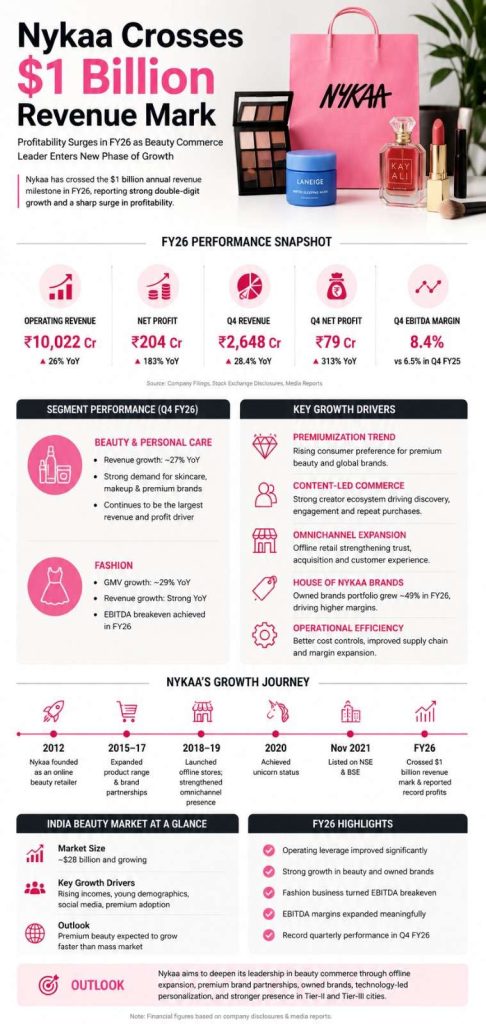
Nykaa reported FY26 operating revenue of ₹10,022 crore, up 26% year-on-year, while net profit surged 183% to ₹204 crore. In the March quarter alone, revenue rose 28.4% to ₹2,648 crore and profit climbed more than fourfold to nearly ₹79 crore.
The numbers underline a broader shift in India’s digital consumer economy: specialized vertical commerce platforms with strong brand positioning and disciplined execution are beginning to outperform broader horizontal marketplaces in both growth quality and profitability.
A Defining Milestone for Nykaa
Founded in 2012 by Falguni Nayar, Nykaa began as an online beauty retailer at a time when India’s beauty ecommerce market was still nascent.
Over the past 14 years, the company expanded into fashion, private labels, offline retail, influencer-led commerce, premium global beauty partnerships, and B2B distribution. Its FY26 performance suggests that several of those long-term bets are now beginning to scale simultaneously.
According to company disclosures, Nykaa’s cumulative revenue crossed the $1 billion threshold during FY26, marking one of the rare cases of a new-age Indian consumer internet company achieving scale alongside meaningful profitability.
The company’s EBITDA for Q4 FY26 rose 67% year-on-year to ₹223 crore, while EBITDA margins expanded to 8.4% from 6.5% a year earlier.
That margin expansion is particularly significant because profitability has historically been a challenge for India’s ecommerce ecosystem, where discounting, logistics costs, and customer acquisition expenses have often weighed heavily on earnings.
Beauty Business Continues to Power Growth
Nykaa’s core beauty and personal care (BPC) division remains the company’s primary growth engine.
The beauty segment recorded roughly 27% growth in Q4 FY26, supported by strong consumer demand for skincare, makeup, fragrances, and premium international labels.
Unlike horizontal ecommerce platforms that compete heavily on price, Nykaa has built a differentiated positioning around premiumization, curated assortments, authenticity, and content-led discovery. That strategy has helped the company maintain stronger gross margins than many broader ecommerce peers.
Industry analysts say India’s beauty market is currently benefiting from three structural trends:
1. Premium Beauty Adoption
Urban consumers are increasingly spending on premium skincare and cosmetics products, especially across Gen Z and millennial demographics.
International beauty brands such as Fenty Beauty, Estee Lauder, and other luxury labels have seen rising traction in India, aided by social media influence and growing disposable incomes. Nykaa has positioned itself as a key distribution and discovery platform for several global brands.
2. Content-Driven Commerce
Beauty commerce behaves differently from traditional ecommerce categories because product discovery is heavily influenced by creators, tutorials, reviews, and social validation.
Nykaa invested early in creator-led content, beauty education, and omnichannel customer engagement, helping build stronger user retention and repeat purchase behavior.
3. Offline + Online Integration
Unlike several digital-first startups that remained online-centric, Nykaa expanded aggressively into physical retail. Its offline network has become an important acquisition and trust-building channel, especially for premium consumers who prefer product trials before purchase.
House of Nykaa Brands Are Becoming Strategic Assets
One of the most important developments in Nykaa’s business model is the rapid growth of its owned brands portfolio.
The company’s “House of Nykaa” portfolio — which includes labels such as Kay Beauty and Dot & Key — reportedly grew 49% in FY26.
Owned brands typically deliver higher margins than third-party marketplace sales because companies control manufacturing, branding, and pricing. This also reduces dependence on external suppliers and improves long-term unit economics.
For Nykaa, private labels are increasingly becoming central to its profitability strategy.
The shift mirrors global ecommerce trends where platforms are moving beyond pure marketplace models toward hybrid structures that combine retail, private labels, and ecosystem control.
Fashion Segment Shows Early Signs of Stabilization
Nykaa’s fashion vertical has historically lagged the beauty business in profitability and operational efficiency.
However, FY26 marked an important improvement.
The fashion segment reportedly reached EBITDA breakeven during the year due to tighter cost controls, better inventory management, and improving growth momentum.
Fashion GMV grew nearly 29% in Q4 FY26, while revenue from the segment increased meaningfully year-on-year.
While the segment still faces intense competition from players such as Myntra, Ajio, and fast-fashion entrants, analysts view the narrowing losses as a positive signal for Nykaa’s broader platform economics.
Why Investors Are Paying Attention Again
Nykaa’s stock surged after the earnings announcement, with shares touching fresh 52-week highs following the Q4 results.
The renewed investor optimism reflects a larger shift underway in public market sentiment toward Indian internet companies.
For several years after the 2021 tech IPO boom, investors questioned whether consumer internet startups could ever achieve durable profitability without sacrificing growth.
Nykaa’s latest results suggest that selective vertical ecommerce businesses may be able to achieve both.
The company’s improving operating leverage, stronger margins, and disciplined execution are now positioning it differently from loss-heavy ecommerce peers.
Importantly, Nykaa has also avoided some of the excessive cash burn strategies that hurt investor confidence across parts of the startup ecosystem in recent years.
India’s Beauty Market Is Entering a New Growth Cycle
Nykaa’s performance also reflects the rapid evolution of India’s beauty and personal care market.
Reuters estimates place India’s beauty market at roughly $28 billion, with premium beauty expected to outpace mass-market growth over the coming years.
Several structural drivers are contributing to this expansion:
- rising disposable incomes
- increasing female workforce participation
- social commerce and influencer ecosystems
- growing demand from Tier-II and Tier-III cities
- broader adoption of skincare routines among younger consumers
- stronger demand for global beauty brands
India’s beauty market still remains underpenetrated compared to developed economies, giving platforms like Nykaa significant headroom for long-term expansion.
Challenges Still Remain
Despite the strong FY26 performance, Nykaa still faces meaningful execution risks.
Intensifying Competition
The beauty commerce space is becoming increasingly crowded. Large ecommerce players, quick commerce platforms, D2C brands, and global beauty retailers are all competing for the same consumer base.
Quick commerce companies are also entering beauty delivery aggressively, potentially reshaping customer expectations around convenience and fulfillment speed.
Margin Sustainability
While margins improved substantially in FY26, sustaining those gains at scale will remain challenging.
Beauty retail requires ongoing investments in marketing, customer engagement, technology, warehousing, and offline retail expansion.
Fashion Business Volatility
Although the fashion segment improved, the category remains structurally more competitive and operationally complex than beauty.
Achieving durable profitability in fashion will likely require continued inventory discipline and differentiated merchandising.
What Nykaa’s Performance Means for India’s Startup Ecosystem
Nykaa’s FY26 results may carry significance beyond the company itself.
For years, India’s startup ecosystem prioritized rapid scale, market capture, and GMV growth. Investors are now increasingly rewarding businesses that demonstrate capital efficiency, operating discipline, and predictable profitability.
Nykaa appears to be emerging as one of the few large consumer-tech companies successfully navigating that transition.
The company’s trajectory could influence how future Indian consumer startups balance growth and profitability strategies — particularly in categories where brand trust, customer loyalty, and premium positioning matter more than deep discounting.
Outlook
Nykaa enters FY27 with strong momentum across its beauty ecosystem, private labels portfolio, omnichannel retail strategy, and improving operational leverage.
The company is expected to continue investing in:
- offline retail expansion
- premium global brand partnerships
- owned labels
- AI-driven personalization and commerce tools
- content-led customer engagement
- deeper penetration in smaller Indian cities
The larger question now is whether Nykaa can evolve from a successful ecommerce platform into a broader beauty and lifestyle ecosystem company with long-term pricing power and sustained profitability.
Its FY26 results suggest that possibility is becoming increasingly realistic.
Also Read : Ola Faces Fresh Questions Around Profitability and EV Execution
Add Startup Magazine as a preferred source on Google-Click Here
Last Updated on Friday, May 22, 2026 6:00 pm by Startup Magazine Team
About The Author
