China’s entertainment industry has spent the past two decades scaling internet platforms, livestream commerce, and mobile-first social media. Now, another format is rapidly reshaping the country’s digital economy: micro-dramas.
Known locally as duanju, these ultra-short episodic dramas — often filmed vertically for smartphone viewing — have evolved from low-budget clickbait entertainment into one of China’s fastest-growing media businesses. Episodes typically run between one and five minutes, with tightly compressed storytelling built around emotional hooks, cliffhangers, revenge arcs, romance, and social conflict.
What is changing the industry now is not just audience demand, but artificial intelligence.
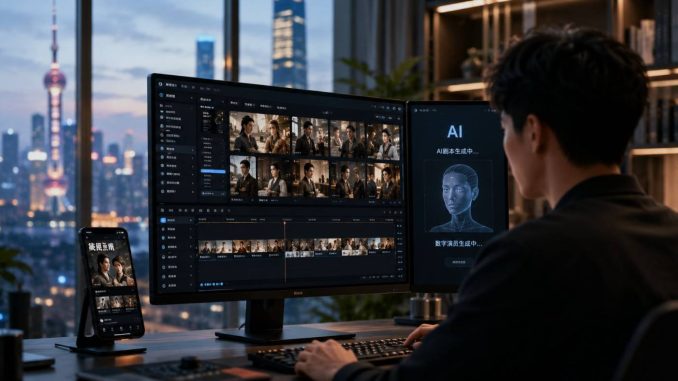
AI tools are increasingly being used across script development, dubbing, animation, editing, localization, recommendation systems, and even fully generated virtual actors. The result is a dramatic reduction in production costs and turnaround times, allowing studios to produce content at industrial scale.
The market impact has become impossible to ignore.
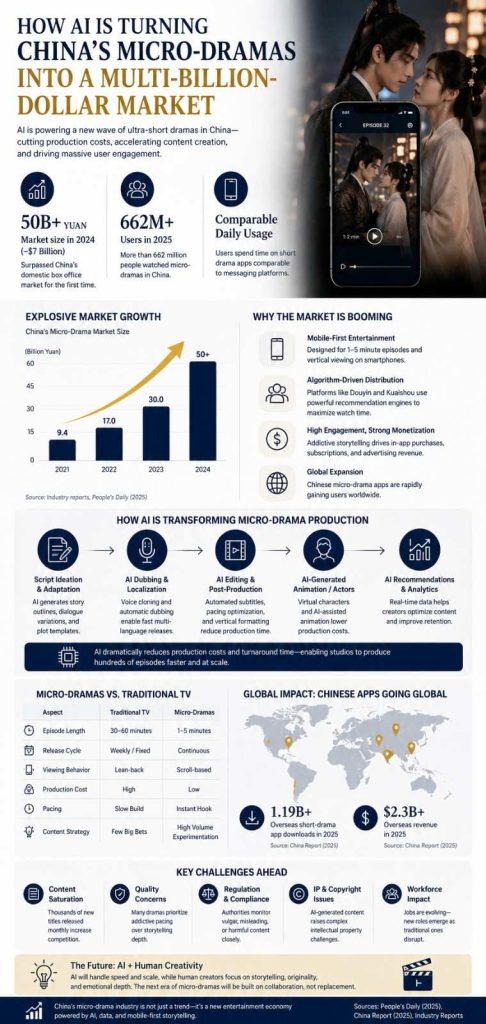
Industry estimates cited by Chinese media and market researchers suggest China’s micro-drama sector surpassed 50 billion yuan (roughly $7 billion) in annual revenue in 2024, overtaking the country’s domestic box office market for the first time.
What began as an internet content niche is increasingly becoming a new model for digital entertainment economics.
The Mobile-First Entertainment Model
Micro-dramas are designed for algorithmic consumption.
Unlike traditional television or streaming productions, these shows are optimized for infinite-scroll platforms such as Douyin, Kuaishou, and Tencent’s video ecosystems. Storylines are accelerated, emotional tension arrives within seconds, and endings are engineered to maximize retention.
The format aligns almost perfectly with smartphone viewing behavior.
Episodes are short enough to consume during commutes, breaks, or between social media sessions. Platforms use recommendation algorithms similar to TikTok feeds, creating highly addictive viewing loops.
By 2025, China reportedly had more than 662 million micro-drama users, according to industry data referenced by People’s Daily.
Audience engagement metrics have also become unusually strong compared to traditional video formats. Chinese media reports indicate users on dedicated short-drama apps spend daily viewing time comparable to messaging platforms.
This behavioral shift is attracting advertisers, platforms, production studios, gaming companies, and AI startups simultaneously.
Why AI Fits the Economics of Micro-Dramas
The micro-drama industry already prioritized speed over cinematic polish. AI amplifies that advantage.
Traditional television productions can take months or years. Micro-dramas can be filmed in weeks. AI-assisted workflows are pushing that timeline even lower.
Studios are now using generative AI for:
Script ideation and adaptation
AI models help producers rapidly generate story variations, dialogue structures, cliffhanger formats, and genre-specific plot templates.
Because micro-dramas rely heavily on repeatable emotional formulas, AI systems are particularly effective at scaling production.
AI dubbing and localization
Voice cloning and automated dubbing allow content to be translated into multiple languages quickly and cheaply, helping Chinese studios expand internationally.
AI editing and post-production
Automated subtitle generation, pacing optimization, scene clipping, and vertical formatting significantly reduce editing workloads.
AI-generated animation and characters
Some companies are experimenting with fully AI-generated animated dramas or virtual actors.
A growing segment of the industry now focuses on AI-native productions rather than merely AI-assisted workflows.
The economic incentives are clear.
According to Business Insider reporting on Beijing-based startup StoReel, AI-generated productions can reduce costs substantially compared to conventional drama production models.
For an industry driven by volume, retention, and rapid experimentation, lower production costs directly translate into higher scalability.
China’s Platforms Are Racing to Dominate the Market
China’s largest internet companies increasingly see micro-dramas as a strategic growth category.
Douyin, Kuaishou, Tencent, Baidu, and other ecosystem players are aggressively investing in creator tools, recommendation infrastructure, and monetization models.
The reason is partly economic.
China’s livestream e-commerce market has matured, and platform growth is slowing in some segments. Short dramas offer a new engagement engine capable of extending user watch time and advertising inventory.
Platforms are also discovering that serialized short-form storytelling creates stronger retention than many traditional short-video formats.
Baidu has publicly highlighted growth in AI-generated animated short dramas, noting strong increases in both content supply and audience consumption.
Chinese platform companies are not merely distributing these dramas — they are becoming infrastructure providers for AI-assisted entertainment production.
That includes offering creators:
- AI editing tools
- Open-source intellectual property assets
- Cloud computing support
- AI voice synthesis
- Recommendation optimization
- Monetization systems
This creates a vertically integrated ecosystem where platforms control both discovery and production economics.
The Global Expansion Strategy
What makes China’s micro-drama boom particularly significant is that it is no longer a domestic-only phenomenon.
Chinese companies are aggressively exporting the format overseas.
Apps such as ReelShort and DramaBox — both linked to Chinese operators — have gained traction internationally, particularly in the United States and Southeast Asia.
The business model travels well because the format itself is platform-native and culturally adaptable.
AI helps accelerate that globalization in several ways:
- faster subtitle generation
- multilingual dubbing
- low-cost localization
- rapid content testing
- personalized recommendations
According to a 2025 industry report referenced by Chinese media, overseas short-drama app downloads surpassed 1.19 billion globally in 2025, while revenue crossed $2.3 billion.
Some analysts expect global micro-drama revenues to continue rising sharply over the next decade. However, long-term forecasts vary significantly across firms and should be treated cautiously because the sector remains relatively young and fragmented.
The Attention Economy Advantage
Micro-dramas succeed because they are optimized for modern attention patterns rather than traditional storytelling structures.
In many ways, the format reflects the broader transformation of internet entertainment:
| Traditional TV | Micro-Dramas |
|---|---|
| 30–60 minute episodes | 1–5 minute episodes |
| Weekly release cycles | Continuous release |
| Lean-back viewing | Scroll-based consumption |
| Cinematic pacing | Constant emotional escalation |
| High production budgets | High-volume rapid production |
AI strengthens this structure because the industry prioritizes iteration over perfection.
Studios can test hundreds of concepts quickly, monitor audience engagement in real time, and adjust future scripts accordingly.
Academic research published in 2026 found that micro-drama writers increasingly adapt storylines based on immediate audience feedback, repost behavior, comments, and engagement signals.
That creates a feedback loop between algorithms, creators, and viewers unlike conventional television production.
The Risks Behind the Boom
Despite the explosive growth, the industry faces several structural concerns.
Content saturation
China’s market is already flooded with thousands of new micro-drama titles monthly.
As AI lowers production barriers further, discoverability becomes harder, increasing pressure on recommendation algorithms.
Quality concerns
Critics argue many micro-dramas prioritize addictive pacing over narrative quality.
Chinese regulators have periodically cracked down on vulgar, misleading, or excessively sensational content.
Intellectual property issues
AI-assisted content creation raises unresolved copyright and training-data concerns, particularly when scripts, voices, or visual styles resemble existing works.
Labor disruption
AI-generated actors, synthetic voices, and automated production workflows may reshape employment across editing, voice acting, and lower-budget production roles.
At the same time, the industry is also creating large numbers of new jobs in mobile entertainment production.
The long-term labor impact remains uncertain.
Why This Matters Beyond China
China’s micro-drama economy may preview the future of mass-market entertainment globally.
The combination of:
- algorithmic distribution,
- generative AI production,
- short-form storytelling,
- and mobile-native viewing
creates a fundamentally different media model from Hollywood or traditional streaming.
Instead of investing heavily in a small number of blockbuster productions, platforms can deploy thousands of lower-cost serialized experiments simultaneously.
That changes:
- production economics,
- advertising models,
- content localization,
- and global distribution dynamics.
Western streaming platforms are already studying the model, while brands increasingly use micro-drama formats for marketing campaigns.
The shift may ultimately resemble what TikTok did to social media — compressing entertainment into algorithmically optimized mobile experiences.
The Future: Human Creativity or AI Content Factories?
China’s micro-drama industry is entering a new phase.
The first stage was explosive scale.
The second is industrial optimization through AI.
The next challenge will likely be differentiation and quality.
As generative tools become commoditized, simply producing content faster may no longer be enough. Platforms and studios will need stronger storytelling, recognizable intellectual property, and higher production standards to maintain audience loyalty.
There is also growing evidence that viewers are beginning to distinguish between repetitive algorithmic storytelling and genuinely compelling narratives.
That may push the industry toward hybrid production models where AI handles operational efficiency while human creators focus on originality, emotional nuance, and cultural relevance.
For now, however, China has built something few expected: a mobile entertainment economy where AI and short-form storytelling are converging into a multi-billion-dollar business with global ambitions.
And the rest of the entertainment industry is paying attention.
Also Read : Nykaa Crosses $1 Billion Revenue Milestone as Profitability Accelerates
Add Startup Magazine as a preferred source on Google-Click Here
Last Updated on Saturday, May 23, 2026 7:53 pm by Startup Magazine Team
About The Author
