
India’s consumer internet economy was built on optimism.
For over a decade, startups promised convenience, financial inclusion, affordable commerce, instant delivery, and democratized access to services. Millions of Indians adopted digital payments, online grocery delivery, fintech apps, edtech platforms, and quick-commerce services at extraordinary speed.
But as the market matures, a different sentiment is beginning to emerge: skepticism.
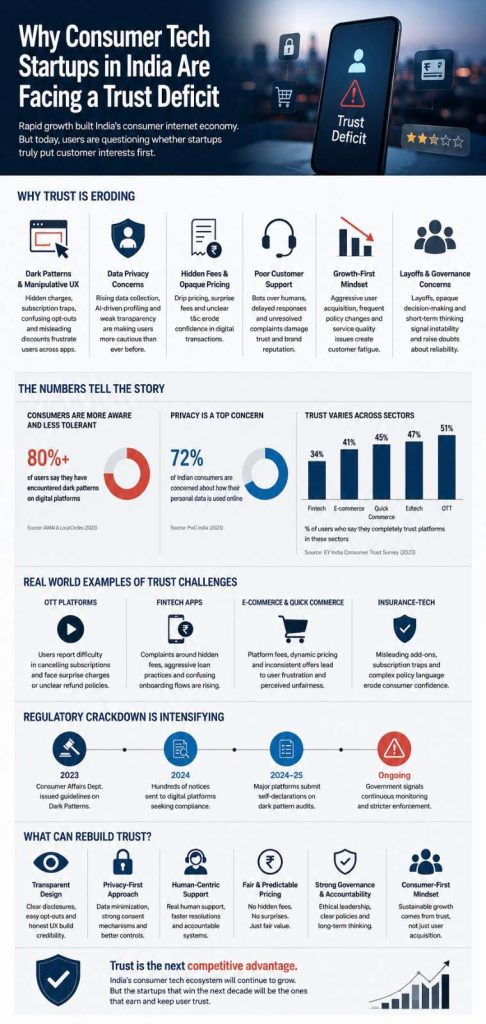
Across categories — from fintech and e-commerce to OTT subscriptions and quick commerce — consumers are increasingly questioning whether startups genuinely prioritize user interests or simply optimize aggressively for growth metrics. The result is a widening trust deficit that could become one of the defining structural challenges for India’s consumer technology ecosystem over the next decade.
This erosion of trust is not driven by a single scandal or sector. Instead, it reflects a combination of dark patterns, data privacy anxieties, inconsistent customer support, opaque pricing, aggressive monetization, layoffs, governance concerns, and unrealistic growth models that have weakened the credibility once enjoyed by digital-first brands.
The issue is no longer anecdotal. Regulators, investors, and consumers are all paying closer attention.
India’s Consumer Tech Story Was Built on Rapid Adoption
India remains one of the world’s largest digital growth markets.
Cheap mobile data, widespread smartphone penetration, UPI adoption, and a young internet-first population helped create fertile ground for consumer startups. Companies in food delivery, e-commerce, fintech, edtech, travel, and streaming scaled at unprecedented speed between 2015 and 2023.
The emphasis during this period was clear: acquire users aggressively.
Venture capital funding rewarded growth, customer acquisition, and market share dominance. Startups spent heavily on discounts, cashback incentives, influencer marketing, and convenience-led expansion.
In many cases, trust was assumed rather than deliberately built.
As long as services were cheaper, faster, or more convenient than traditional alternatives, consumers tolerated operational inefficiencies and evolving business models.
That tolerance is now weakening.
The Rise of “Dark Patterns” Has Become a Major Flashpoint
One of the clearest signs of consumer frustration is the growing scrutiny around “dark patterns” — manipulative user interface techniques designed to influence customer decisions.
India’s government has intensified focus on the issue over the past two years. The Department of Consumer Affairs introduced formal dark-pattern guidelines in 2023, and regulators have since pushed major platforms to conduct audits and compliance reviews.
Common consumer complaints include:
- Hidden cancellation buttons
- Pre-selected add-ons
- Subscription traps
- Drip pricing
- Forced app installs
- Misleading urgency notifications
- Confusing opt-out flows
The problem spans multiple sectors.
OTT platforms have faced criticism for difficult subscription cancellations and surprise charges. Online payment platforms have been accused of hidden fees and manipulative pricing structures. Insurance aggregators and fintech apps have also come under scrutiny for misleading onboarding flows and subscription traps.
Several large platforms have submitted “self-declarations” claiming compliance with anti-dark-pattern guidelines, including companies such as Flipkart, Swiggy, Zomato, and Zepto.
However, questions remain around transparency and independent verification. An RTI-based report by MediaNama found that while multiple companies submitted dark-pattern declarations, the underlying audit reports were not publicly accessible.
This matters because trust is deeply connected to user perception. Even if a platform technically complies with regulations, users increasingly notice when interfaces feel manipulative.
The long-term risk for startups is reputational, not merely regulatory.
Consumers Are Becoming More Sensitive About Data Privacy
Data privacy is emerging as another major pressure point.
For years, Indian consumers accepted extensive data sharing in exchange for convenience. But growing awareness around AI, targeted advertising, spam calls, financial fraud, and algorithmic profiling has changed public sentiment.
The implementation trajectory of India’s Digital Personal Data Protection (DPDP) framework has intensified industry discussions around consent, data collection, and compliance readiness.
Many startups now face a difficult balancing act:
- personalized experiences require more data,
- but excessive data collection creates distrust.
The problem is especially visible in fintech, health-tech, and AI-enabled consumer platforms where users share highly sensitive financial or behavioral information.
Industry surveys increasingly show a gap between how executives and consumers perceive technology risks. An EY India survey published in 2025 found that many CXOs acknowledged challenges around AI governance and risk management.
Trust in digital platforms is no longer just about app functionality. It is becoming tied to:
- transparency,
- explainability,
- data governance,
- and ethical product design.
Growth-at-All-Costs Culture Damaged Consumer Confidence
The venture capital era of “growth first, sustainability later” created unintended consequences for user trust.
Many startups optimized heavily for:
- daily active users,
- GMV growth,
- retention metrics,
- referral loops,
- and monetization experiments.
Consumers often became part of aggressive experimentation cycles.
Frequent policy changes, inconsistent pricing, disappearing offers, declining service quality after market capture, and sudden layoffs contributed to the perception that some startups prioritized investor optics over customer reliability.
The issue became more pronounced during the funding slowdown that began after the global tech correction.
As capital became harder to access, many consumer startups shifted from subsidized growth to profitability-focused models. Users who had become accustomed to low-cost services suddenly faced:
- higher platform fees,
- reduced rewards,
- more advertising,
- premium subscriptions,
- and stricter monetization.
This transition exposed a difficult reality: loyalty built primarily through discounts is fragile.
Trust Erodes Faster in Fintech Than in Other Categories
Among all consumer startup sectors, fintech faces perhaps the greatest trust challenge.
Financial products inherently require credibility because users are entrusting platforms with:
- money,
- identity data,
- transaction histories,
- and behavioral information.
Even small operational failures can significantly damage perception.
Consumers increasingly expect fintech apps to deliver:
- bank-level security,
- transparent pricing,
- responsive grievance resolution,
- and fraud protection.
At the same time, AI-driven fraud, deepfake scams, and digital impersonation risks are growing globally. This has made users more cautious about newer financial platforms, particularly lesser-known startups.
The broader fintech ecosystem is also facing increased scrutiny around:
- digital lending practices,
- mis-selling,
- hidden charges,
- and consent mechanisms.
Unlike entertainment or commerce apps, financial trust is difficult to regain once broken.
Customer Support Failures Are Becoming a Reputation Risk
Another major contributor to distrust is the decline of effective customer support.
Many high-growth startups automated support systems aggressively to reduce operational costs. While automation improved scalability, it often weakened accountability.
Users across sectors increasingly report frustrations around:
- inaccessible human support,
- unresolved refund disputes,
- delayed complaint handling,
- and algorithm-driven decision-making with little transparency.
In categories like travel, fintech, healthcare, and insurance, poor support experiences create disproportionate reputational damage because customers interact with these platforms during stressful or time-sensitive situations.
The irony is that startups originally differentiated themselves through better user experience than incumbents. In several sectors, consumers now complain that digital-first companies have become harder to deal with than traditional businesses.
The Trust Gap Between Founders and Consumers Is Growing
A less discussed issue is the widening psychological gap between startup leadership narratives and consumer expectations.
Founders often frame operational compromises as:
- scaling challenges,
- monetization realities,
- or growth experiments.
Consumers interpret the same actions differently:
- hidden fees feel deceptive,
- forced subscriptions feel manipulative,
- excessive notifications feel intrusive,
- and abrupt policy changes feel unreliable.
This perception gap is amplified by social media.
Negative experiences now spread rapidly through Reddit discussions, LinkedIn posts, YouTube commentary, and consumer forums. Public criticism that once stayed niche now shapes mainstream perception within hours.
The modern consumer startup environment is far less forgiving than the hypergrowth era of the late 2010s.
Regulation Is Moving From Reactive to Proactive
Indian regulators are signaling a broader shift toward consumer protection in digital markets.
Authorities have increasingly focused on:
- dark patterns,
- platform accountability,
- digital lending practices,
- advertising disclosures,
- and user consent frameworks.
The government has reportedly issued hundreds of notices related to manipulative interface practices. Consumer Affairs Minister Pralhad Joshi has also publicly stated that dark patterns are continuously evolving and require ongoing oversight rather than a one-time regulatory solution.
This indicates a larger transition in India’s startup ecosystem:
from innovation-first regulation to trust-first regulation.
For founders, compliance may soon become a competitive differentiator rather than merely a legal obligation.
The Next Wave of Winners May Be Trust-Centric Companies
The consumer tech market is unlikely to slow dramatically. India’s digital adoption story remains structurally strong.
But the next generation of successful startups may look very different from the previous decade’s growth models.
Future leaders are likely to prioritize:
- transparent pricing,
- ethical UX design,
- stronger governance,
- privacy-first infrastructure,
- reliable customer support,
- sustainable monetization,
- and long-term brand credibility.
Trust is becoming a product feature.
This transition mirrors what happened in more mature digital economies, where consumers eventually began rewarding reliability and transparency over pure growth velocity.
Investors are also changing priorities. Many VCs now evaluate governance quality, compliance readiness, and retention durability more closely than they did during the peak funding boom.
That shift could ultimately create healthier businesses.
Conclusion
India’s consumer startup ecosystem is not facing a collapse of innovation. It is facing a credibility reset.
The hypergrowth era prioritized scale, speed, and market capture. The next phase will likely reward accountability, transparency, and durable consumer relationships.
Trust deficits rarely emerge overnight, and they are difficult to repair once normalized.
For Indian consumer startups, the challenge is no longer just building products people use. It is building companies people genuinely trust.
The startups that understand this early may define the next decade of India’s digital economy.
Also Read : How AI Is Turning China’s Micro-Dramas Into a Multi-Billion-Dollar Market
Add Startup Magazine as a preferred source on Google-Click Here
Last Updated on Monday, May 25, 2026 9:14 pm by Startup Magazine Team
About The Author
