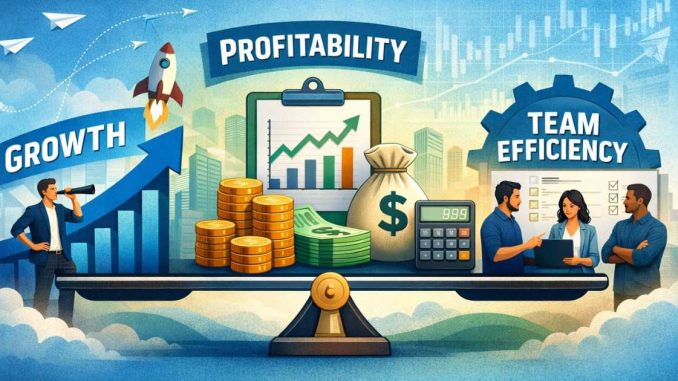
In the current startup climate, the conversation around success has undergone a fundamental shift. Growth alone is no longer the defining metric for founders. Instead, the spotlight has moved to a more nuanced challenge: how effectively leaders can balance expansion, profitability, and team efficiency at the same time. As capital becomes more selective and operating environments more demanding, this balancing act has emerged as a central theme shaping boardroom discussions and founder decision-making.
Over the past few years, rapid growth was often rewarded without sufficient scrutiny of sustainability. Startups were encouraged to prioritise market share, user acquisition, and top-line expansion, sometimes at the cost of sound financial fundamentals. However, as funding conditions tightened and investors became more risk-conscious, many companies were forced to reassess their strategies. The result has been a renewed focus on disciplined growth, where scale is pursued alongside a clear understanding of costs, margins, and long-term value creation.
Founders are increasingly redefining what growth means for their businesses. Rather than chasing headline numbers, many are placing greater emphasis on customer retention, recurring revenue, and predictable demand. This shift reflects a broader industry realisation that not all growth strengthens a company. Expansion that relies heavily on discounts, aggressive spending, or operational strain can undermine profitability and weaken organisational stability. In contrast, measured growth built on strong unit economics is proving to be more resilient in uncertain markets.
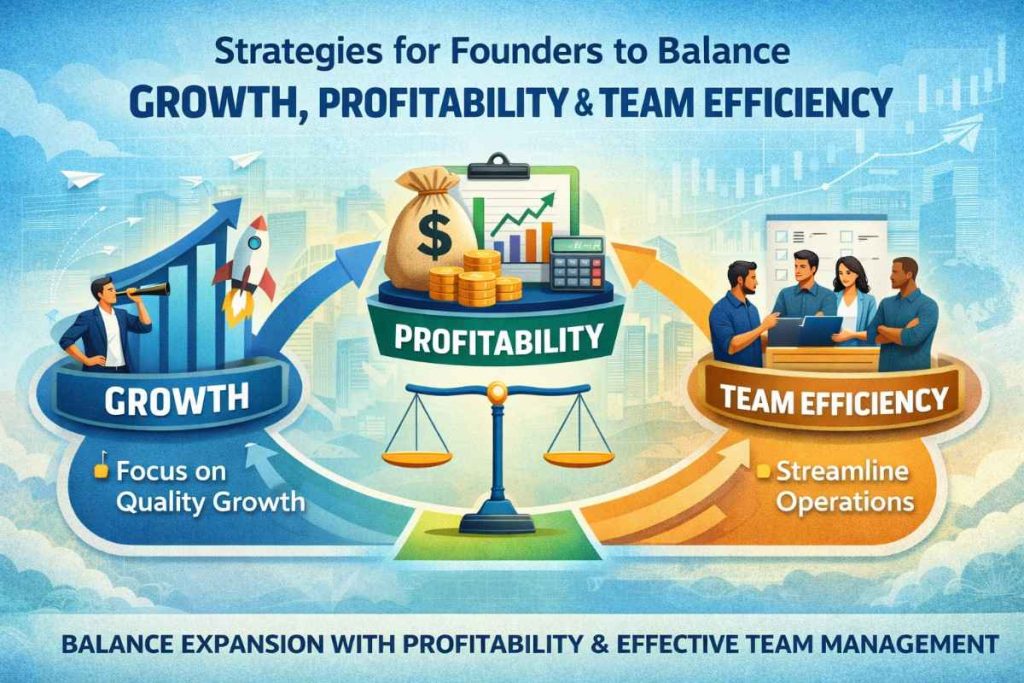
Profitability, once viewed as a milestone for later stages of a startup’s journey, has moved closer to the centre of strategic planning. While few early-stage companies are expected to be immediately profitable, there is growing pressure on founders to demonstrate a credible path toward it. This has pushed financial discipline higher up the leadership agenda. Founders are now expected to engage deeply with cash flow management, cost structures, and burn rates, ensuring that growth initiatives are backed by realistic financial assumptions.
Team efficiency has emerged as a critical factor linking growth ambitions with profitability goals. As startups scale, inefficiencies can multiply quickly, particularly when hiring outpaces the development of processes and management structures. Industry observers note that many founders are responding by investing earlier in systems that support coordination and accountability. Clear role definitions, measurable objectives, and streamlined decision-making processes are increasingly seen as essential tools for maintaining momentum without inflating costs.
At the same time, founders face the challenge of preserving agility while introducing structure. Excessive layers of approval or rigid processes can slow execution and dampen innovation. The most effective leaders are those who strike a balance, implementing just enough structure to support scale while allowing teams the autonomy to move quickly. This approach not only improves productivity but also helps retain talent in competitive labour markets.
Investor expectations have played a significant role in reinforcing these priorities. Venture capital firms and institutional investors are placing greater weight on operational efficiency and capital allocation discipline. Founders are now routinely asked to justify hiring plans, marketing spend, and expansion strategies in terms of long-term value rather than short-term growth spikes. This change has influenced how startups plan their growth trajectories and communicate progress to stakeholders.
Cultural factors also influence how successfully companies manage this balance. Transparency from leadership has become increasingly important, particularly during periods of adjustment or cost control. When teams understand the rationale behind strategic decisions, they are more likely to remain engaged and aligned with company goals. Analysts suggest that open communication and shared accountability can significantly enhance efficiency, especially during times of uncertainty.
As the startup ecosystem continues to mature, balancing growth, profitability, and team efficiency is no longer seen as a trade-off but as a core leadership capability. The founders who navigate this complexity effectively are better positioned to build durable businesses, capable of adapting to market shifts and sustaining performance beyond initial phases of expansion. In an era defined by cautious optimism and heightened scrutiny, this balanced approach is increasingly becoming the benchmark for long-term success.
Add startupmagazine.in as preferred source on google – Click Here
Last Updated on Friday, January 23, 2026 2:35 pm by Startup Magazine Team
About The Author
