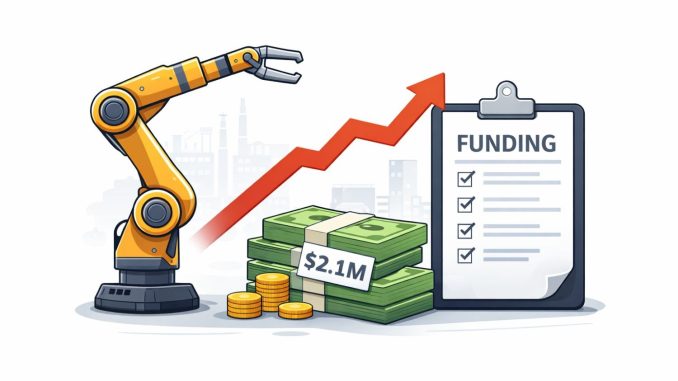
Indian robotics startup Armatrix has raised $2.1 million in fresh funding to expand its automation solutions across manufacturing and industrial sectors. The capital infusion highlights growing investor confidence in India’s robotics and automation ecosystem at a time when industries are accelerating digital transformation.
The funding comes amid rising demand for smart factories, AI-driven robotics, and cost-efficient automation tools. As Indian businesses seek higher productivity and global competitiveness, startups like Armatrix are attracting attention.
Here is a detailed look at what this funding means for the company and India’s robotics landscape.
Armatrix Secures $2.1 Million to Expand Operations
Armatrix has raised $2.1 million in a recent funding round aimed at scaling its robotics automation platform in India.
The company focuses on building robotic systems and automation tools designed for industrial use. These systems help factories streamline repetitive tasks, improve efficiency, and reduce operational errors.
With the new capital, Armatrix plans to strengthen product development, expand its team, and increase market reach.
While detailed investment terms have not been publicly disclosed, the funding size signals early-stage growth momentum.
Why This Funding Matters Now
India’s manufacturing and logistics sectors are undergoing rapid change.
Companies are increasingly adopting:
Industrial robotics
AI-based inspection systems
Automated material handling
Smart assembly lines
Automation is no longer limited to large multinational corporations. Mid-sized Indian manufacturers are also exploring robotics to reduce costs and improve consistency.
The $2.1 million raise reflects investor belief that robotics automation will become a core part of India’s industrial growth story.
India’s Robotics Market: A Growth Phase
India’s robotics market is still developing compared to countries like Japan, South Korea, and Germany.
However, adoption is steadily rising.
Key drivers include:
Government push for “Make in India”
Growth in automotive and electronics manufacturing
Expansion of e-commerce logistics
Need for precision and quality control
Automation reduces manual errors and improves output speed. For export-focused companies, consistent quality standards are critical.
Startups such as Armatrix are working to make robotics more affordable and accessible for Indian businesses.
Focus Areas for Armatrix
Armatrix develops robotics systems that can be integrated into existing industrial setups.
Common applications in the sector include:
Pick-and-place robots
Welding and assembly automation
Inspection and quality testing systems
Warehouse robotics
The funding is expected to support research and development, allowing the company to refine its hardware and software integration.
Scaling also involves strengthening after-sales service and deployment networks across industrial hubs.
Automation and MSMEs
India’s micro, small, and medium enterprises (MSMEs) represent a large part of the manufacturing economy.
Historically, automation adoption among MSMEs has been limited due to cost concerns.
However, as robotics becomes more modular and scalable, smaller firms are exploring automation to stay competitive.
If startups like Armatrix can provide cost-effective solutions, the addressable market could expand significantly.
Affordable robotics tailored for Indian conditions may become a major growth opportunity.
Investor Interest in Deep Tech Startups
The $2.1 million funding round highlights a broader trend.
Deep tech startups in robotics, AI, and industrial automation are drawing interest from investors who see long-term potential.
Unlike consumer internet startups, robotics companies often require higher upfront investment in hardware development and testing.
However, they also address large industrial markets.
Investors are increasingly backing startups that combine software intelligence with physical automation.
Role of AI in Robotics Automation
Modern robotics systems rely heavily on artificial intelligence.
AI enables machines to:
Identify defects
Adapt to changing inputs
Learn from data
Improve operational accuracy
By combining robotics hardware with AI software, startups can deliver smarter automation.
If Armatrix integrates AI-driven analytics into its systems, it can offer value beyond basic mechanical automation.
This trend aligns with global Industry 4.0 practices.
Challenges Ahead
Despite strong growth potential, robotics startups face several challenges.
These include:
High capital expenditure requirements
Long sales cycles in industrial sectors
Integration complexity with legacy systems
Need for skilled technical workforce
Indian manufacturers often evaluate return on investment carefully before adopting new technology.
Startups must demonstrate clear cost savings and efficiency gains.
Scaling robotics solutions across diverse industries requires robust support infrastructure.
Government Policy and Automation Push
India’s industrial policies increasingly support advanced manufacturing.
Production-linked incentive schemes have encouraged domestic production in sectors such as electronics and automotive.
Automation plays a key role in meeting global quality benchmarks.
Government focus on digital infrastructure and skill development also supports robotics growth.
Skill India and other training initiatives aim to prepare the workforce for automation-led industries.
Global Competition and Export Potential
Indian robotics startups not only compete domestically but also face global competition.
International robotics giants operate in India through partnerships and distribution networks.
However, local startups have an advantage in customising solutions for Indian factory conditions.
Cost competitiveness can also open export opportunities in emerging markets.
If Armatrix scales effectively, it could target Southeast Asia, the Middle East, or Africa in the future.
Impact on Employment
Automation often raises concerns about job displacement.
However, industry experts note that robotics also creates new job roles in:
Robot programming
Maintenance
System integration
Data analysis
As factories modernise, demand for skilled technicians increases.
The key challenge is workforce reskilling and training.
Automation shifts the nature of jobs rather than eliminating them entirely.
Startup Ecosystem and Funding Climate
India’s startup ecosystem has matured over the past decade.
While consumer tech once dominated funding headlines, deep tech startups are gaining visibility.
The $2.1 million raised by Armatrix reflects early-stage investor confidence in industrial innovation.
Funding in robotics often supports:
Prototype development
Pilot projects
Manufacturing scale-up
Client acquisition
Sustained growth will depend on securing repeat orders and building long-term industrial partnerships.
What This Means for Indian Industry
The funding signals a steady shift toward technology-driven manufacturing.
As companies aim to increase output and meet global standards, automation will likely become more common.
Startups like Armatrix can act as technology partners for factories undergoing digital transformation.
For Indian industry, robotics adoption could lead to:
Higher productivity
Improved safety
Better export competitiveness
Reduced operational errors
Looking Ahead
With $2.1 million in new capital, Armatrix now enters a scaling phase.
The next milestones will likely include:
Expansion into new industrial regions
Strengthening partnerships with manufacturers
Enhancing AI integration
Improving deployment efficiency
The success of robotics startups will depend on balancing innovation with practical execution.
Conclusion
Armatrix’s $2.1 million funding round highlights growing interest in robotics automation in India.
As industries modernise and seek higher efficiency, demand for intelligent automation solutions is rising.
The investment underscores the expanding role of deep tech startups in shaping India’s manufacturing future.
If executed well, this funding could position Armatrix as a strong player in India’s emerging robotics ecosystem, contributing to the country’s broader industrial transformation.
Disclaimer: The information presented in this article is intended for general informational purposes only. While every effort is made to ensure accuracy, completeness, and timeliness, data such as prices, market figures, government notifications, weather updates, holiday announcements, and public advisories are subject to change and may vary based on location and official revisions. Readers are strongly encouraged to verify details from relevant official sources before making financial, investment, career, travel, or personal decisions. This publication does not provide financial, investment, legal, or professional advice and shall not be held liable for any losses, damages, or actions taken in reliance on the information provided.
Edited by mantena sasank
Last Updated on Friday, February 27, 2026 12:09 pm by Startup Magazine Team
About The Author
