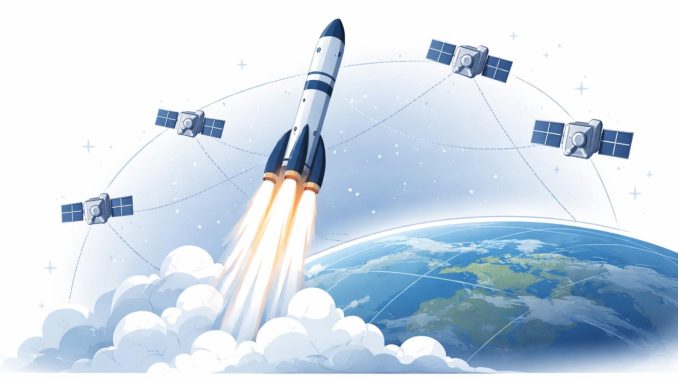
Indian private space startup Skyroot Aerospace has deployed its first commercial satellite constellation, marking a major step for the country’s growing private space industry. The milestone signals India’s transition from government-led missions to commercially driven space services.
The deployment highlights the increasing role of private companies in satellite launches, communication services, and space-based applications. It also reflects the government’s push to open the space sector to startups and private investment.
Skyroot’s First Commercial Constellation Goes Live
Skyroot Aerospace has successfully deployed its first commercial satellite constellation, entering the operational phase of space-based services. The constellation is designed to support commercial customers across sectors such as communication, earth observation, and data services.
This marks the company’s first major commercial deployment after its earlier demonstration missions. The move places Skyroot among a small group of Indian private firms actively launching and operating satellites.
The development is being seen as a key milestone not only for the company but also for India’s private space ecosystem.
Why This Launch Matters
The deployment represents a major shift in India’s space sector, which was traditionally dominated by the Indian Space Research Organisation (ISRO). With policy changes in recent years, private companies have been allowed to build, launch, and operate satellites.
Skyroot’s constellation signals that Indian startups are now moving beyond test launches and entering real commercial operations.
This transition creates new business opportunities in satellite services, attracts global investment, and positions India as a competitive player in the commercial space market.
About Skyroot Aerospace
Skyroot Aerospace is a Hyderabad-based space startup founded in 2018 by former ISRO scientists. The company focuses on building small satellite launch vehicles and space services.
Its primary product line is the Vikram series of rockets, designed to carry small satellites into low Earth orbit.
Skyroot gained national attention after successfully launching the Vikram-S rocket in 2022, which became India’s first private rocket launch.
Since then, the company has been working toward regular commercial launches and satellite deployments.
What the Satellite Constellation Will Do
The new constellation is designed to deliver commercial space-based services to businesses and government clients.
Typical services from such constellations include earth observation and imaging, communication and connectivity, data analytics for agriculture and climate, and maritime and logistics tracking.
Constellations, which involve multiple satellites working together, allow for more frequent data coverage and higher service reliability compared with single satellites.
India’s Growing Private Space Ecosystem
Skyroot’s deployment reflects a broader shift in India’s space industry.
In recent years, the government has introduced reforms to open the sector to private players. New policies have allowed startups to build rockets, operate satellites, and offer commercial space services.
This has led to the rise of several space startups focusing on launch vehicles, satellite manufacturing, and space data applications.
The private sector is expected to play a major role in increasing India’s share of the global space economy.
Global Demand for Satellite Constellations
Satellite constellations are becoming a major part of the global space industry. Companies around the world are launching networks of small satellites to provide services such as broadband internet, earth observation, and navigation.
These constellations offer faster data refresh rates, lower launch costs per satellite, scalable infrastructure, and wider global coverage.
As demand for real-time data grows, constellations are becoming essential for industries ranging from agriculture to defence.
Competition in the Small Satellite Market
The small satellite launch and constellation market is becoming increasingly competitive.
Globally, several companies are focusing on small satellite launches and constellations. The demand for low Earth orbit satellites is expected to grow rapidly over the next decade.
Indian startups are now trying to capture a share of this market by offering cost-efficient launch and satellite solutions.
Skyroot’s commercial deployment positions it among the early movers from India in this space.
Technology Behind Skyroot’s Approach
Skyroot focuses on small, flexible rockets designed for quick and cost-efficient launches. Its Vikram series uses modern manufacturing techniques, including advanced materials and modular designs.
Key features of the company’s approach include rapid launch readiness, lower manufacturing costs, customised orbits for customers, and high launch frequency potential.
This model is aimed at meeting the growing demand from small satellite operators worldwide.
Impact on India’s Space Economy
The successful deployment of a commercial constellation could have a wide impact on India’s space sector.
It could lead to increased private investment in space startups, new commercial services based on satellite data, job creation in advanced engineering sectors, and a higher global market share for Indian space firms.
India’s space economy is currently a small part of the global market, but policymakers aim to increase its share significantly in the coming years.
Support from Policy Reforms
Recent policy changes have made it easier for private companies to operate in the space sector.
Reforms include opening satellite launches to private firms, allowing commercial use of space-based data, creating regulatory frameworks for private space missions, and establishing agencies to support startups.
These changes have encouraged investors and entrepreneurs to enter the space industry.
Challenges Ahead
Despite the milestone, Skyroot and other space startups face several challenges.
1) High Capital Requirements
Space technology requires large investments in research, manufacturing, and testing.
2) Global Competition
Indian startups must compete with well-funded global space companies.
3) Launch Reliability
Commercial customers demand consistent and reliable launch performance.
4) Regulatory Complexity
Operating satellites and launch vehicles involves strict regulatory approvals.
What This Means for Customers and Investors
Skyroot’s commercial constellation could open new opportunities for businesses that rely on satellite data. Industries such as agriculture, logistics, climate monitoring, and telecom may benefit from improved access to space-based services.
For investors, the deployment shows that Indian space startups are moving from prototype stages to revenue-generating operations.
This shift could attract more funding into the space technology sector.
Outlook
The deployment of Skyroot Aerospace’s first commercial satellite constellation marks a major milestone for India’s private space industry. It shows that domestic startups are now capable of delivering real commercial space services.
As global demand for satellite data and connectivity continues to rise, Indian space companies are expected to play a larger role in the international market.
For Skyroot, the constellation marks the beginning of a new phase focused on scaling launches, expanding services, and competing globally in the fast-growing space economy.
Disclaimer: The information presented in this article is intended for general informational purposes only. While every effort is made to ensure accuracy, completeness, and timeliness, data such as prices, market figures, government notifications, weather updates, holiday announcements, and public advisories are subject to change and may vary based on location and official revisions. Readers are strongly encouraged to verify details from relevant official sources before making financial, investment, career, travel, or personal decisions. This publication does not provide financial, investment, legal, or professional advice and shall not be held liable for any losses, damages, or actions taken in reliance on the information provided.
Last Updated on Tuesday, February 10, 2026 11:08 am by Startup Magazine Team
About The Author
