
For first-time entrepreneurs, the seed round often feels like a paradox. Investors insist they are backing vision, not spreadsheets, yet founders are still expected to walk into meetings armed with answers to questions that sound analytical, strategic, and unforgiving. The reality is that seed funding sits at the intersection of belief and evidence. It is the stage where ideas are fragile, markets are still forming, and companies are more potential than proof. Understanding what investors truly look for at this moment can make the difference between a promising conversation and a closed round.
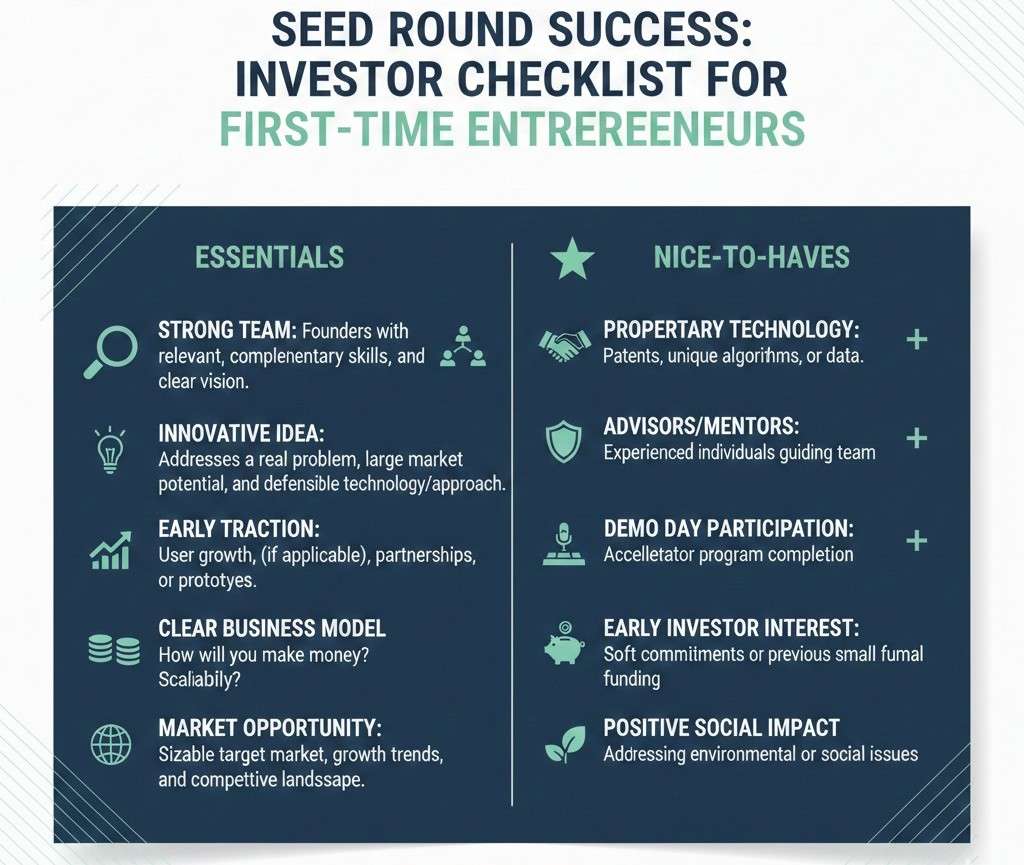
At the heart of every seed investment lies the problem. Investors begin by asking whether the startup is addressing a real, meaningful issue and whether that issue is painful enough for customers to actively seek a solution. Vague or generic problems rarely survive scrutiny. What resonates instead are problems that are clearly defined, frequently encountered, and costly in terms of time, money, or missed opportunity. Founders who can describe the problem with precision and empathy signal that they are not chasing trends but responding to genuine needs.
Closely tied to the problem is the founder’s relationship with it. Seed investors pay close attention to why this particular team is building this particular company. First-time entrepreneurs often underestimate how powerful this narrative can be. A founder who has experienced the problem firsthand or has deep exposure to the industry carries an intuitive advantage. This founder–problem fit reassures investors that the team will persist through inevitable setbacks because their motivation is rooted in understanding, not abstraction.
The solution itself, at the seed stage, does not need to be perfect, but it must be credible. Investors look for evidence that the product or service meaningfully addresses the problem in a way that existing alternatives do not. This is where clarity matters more than complexity. A simple, well-explained solution that delivers clear value often beats an over-engineered product with a confusing pitch. What matters most is whether the solution demonstrates a thoughtful approach to the customer’s pain and shows room to evolve as feedback comes in.
Market opportunity is another pillar of the seed evaluation. Investors are not merely asking whether customers exist today, but whether the market has the potential to grow into something substantial over time. First-time founders sometimes make the mistake of inflating market sizes with broad statistics. Experienced investors, however, listen for a grounded understanding of the initial target market and a logical path to expansion. A focused entry point paired with a credible long-term vision often inspires more confidence than grand but unrealistic projections.
Traction, even in its earliest forms, carries significant weight. While seed investors do not expect massive revenues, they do look for signals that the market is responding. This could take many forms: early users who are actively engaged, pilot customers who are willing to give feedback, or even strong indicators of demand such as waitlists or repeat usage. What investors care about is momentum. They want to see that the startup is not stuck in theory but has begun interacting with real customers in meaningful ways.
Equally important is the team behind the idea. In seed rounds, investors are often betting more on people than on products. For first-time entrepreneurs, this means demonstrating complementary skills, clear roles, and the ability to execute. A solo founder is not a disadvantage, but investors will look closely at whether that founder has the capacity to build, sell, and adapt, or whether there is a plan to bring in additional talent. Transparency about strengths and gaps is often viewed more positively than overconfidence.
Execution mindset plays a subtle yet critical role. Investors observe how founders think through problems, respond to challenges, and incorporate feedback. Seed-stage startups inevitably change direction, and investors want teams that are flexible without being directionless. Founders who can explain what they have learned so far, what assumptions have been tested, and what might change next signal maturity beyond their years. This learning velocity often matters more than early success itself.
The business model, even if still evolving, must show signs of viability. Investors understand that pricing and revenue streams may shift, but they want to see that the founder has thought seriously about how the company could eventually make money. A clear logic linking customer value to revenue builds confidence that the startup is not relying solely on growth narratives without economic grounding.
Finally, investors assess trust and integrity, often in ways founders do not immediately notice. Consistency in storytelling, honesty about risks, and realism about challenges all contribute to this assessment. Overly polished pitches that gloss over uncertainties can raise red flags, while thoughtful acknowledgment of risks paired with credible mitigation plans can strengthen belief.
For first-time entrepreneurs, seed fundraising is as much about learning as it is about capital. Investors are not expecting flawless execution or guaranteed outcomes. They are looking for sharp thinking, genuine insight, and the ability to turn an idea into a learning machine. Those who understand this shift—from proving certainty to demonstrating potential—are often the ones who leave the room not just with feedback, but with funding.
Also Read : https://startuptimes.in/generative-ai-in-retail-key-digital-transformation-strategies-for-indian-d2c-brands/
Add startupmagazine.in as preferred source on google – Click Here
Last Updated on Tuesday, February 3, 2026 7:08 pm by Startup Magazine Team
About The Author
