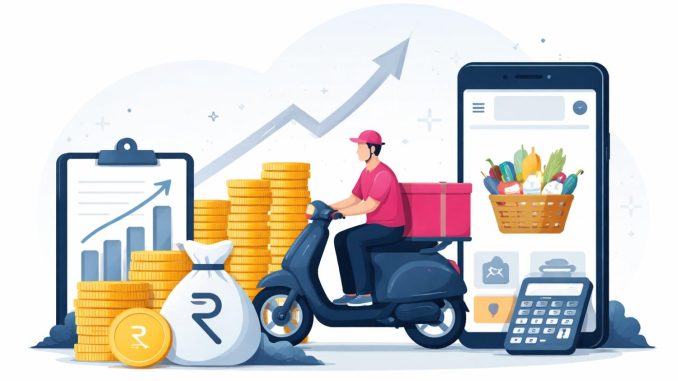
Quick commerce startup Zepto has reached EBITDA breakeven ahead of its planned FY27 initial public offering, marking a major milestone for the fast-growing grocery delivery sector in India. The development signals a shift from rapid expansion and heavy cash burn to a stronger focus on profitability as the company prepares to enter public markets.
The move comes at a time when investors are demanding clearer paths to profits from high-growth startups. For Zepto, achieving EBITDA breakeven earlier than expected could strengthen its IPO prospects and boost confidence among institutional investors.
EBITDA Breakeven Achieved Ahead of IPO Timeline
Zepto has reportedly reached EBITDA breakeven ahead of its scheduled FY27 IPO filing. The company had earlier targeted profitability at the EBITDA level within the next 12–15 months as part of its IPO preparation strategy.
EBITDA, or earnings before interest, taxes, depreciation, and amortisation, is a key measure of operating performance. For startups, reaching EBITDA breakeven is often seen as a major turning point, showing that core operations can sustain themselves without heavy losses.
The quick commerce firm had been working to reduce cash burn and improve operating efficiency over the past year. Earlier, the company had significantly reduced EBITDA losses and operating cash burn as it moved closer to profitability.
IPO Filing Expected in FY27
Zepto is preparing for a public listing expected in FY27, with a confidential draft filing already completed. The company is reportedly planning an IPO worth about ₹11,000 crore at a valuation between $7 billion and $8 billion.
The listing is likely to take place in the July–September quarter of FY27, according to earlier reports on the company’s IPO roadmap.
The company has also taken several structural steps to prepare for the public markets, including corporate restructuring and increased domestic ownership to meet listing requirements.
Rapid Growth but Heavy Losses in Previous Years
Zepto’s path to profitability comes after a period of rapid growth and significant losses. The company reported ₹9,669 crore in revenue for FY25, more than doubling year on year. However, its net loss also rose to around ₹3,367 crore during the same period.
This pattern is common across the quick commerce industry, where companies invest heavily in dark stores, logistics, and customer acquisition to build scale.
India’s instant delivery market has expanded quickly, driven by a young, mobile-first consumer base and dense urban clusters that make ultra-fast delivery viable.
Shift from Growth to Profitability
The company’s move toward EBITDA breakeven reflects a broader shift in India’s quick commerce sector. After years of aggressive expansion, companies are now focusing on improving unit economics and increasing average order values.
Quick commerce platforms are pushing bulk purchases and planned orders to raise average cart sizes and improve margins. This helps offset the high costs associated with 10-minute delivery, including dark store rentals, rider payouts, logistics infrastructure, and discount-driven customer acquisition.
Industry analysts note that it typically takes around 12–18 months for a dark store to break even, depending on order density and location.
Strong Funding and Valuation Growth
Zepto has raised large amounts of capital over the past two years to fuel its expansion.
The company has secured more than $2.3 billion in total funding since its launch, with major rounds pushing its valuation to about $7 billion ahead of the planned IPO.
A recent funding round alone brought in $450 million, highlighting strong investor interest despite ongoing competition in the sector.
Competition in the Quick Commerce Market
India’s quick commerce market is highly competitive, with major players including Blinkit, Swiggy Instamart, and Zepto.
While some competitors have reported improving margins, many still face high losses due to intense discounting and rapid expansion. Analysts expect the competition to remain intense through the next few years as companies race to capture market share and build dense delivery networks.
Business Model and Expansion Strategy
Founded in 2021, Zepto operates a network of dark stores across major Indian cities to deliver groceries and daily essentials in minutes.
The company’s model relies on dense urban store networks, fast delivery logistics, high order frequency, and technology-driven inventory management. This approach has helped Zepto grow quickly, but it has also required heavy investment in infrastructure and marketing.
Why EBITDA Breakeven Matters for the IPO
Achieving EBITDA breakeven is a key signal for public market investors. It shows that a company’s core operations can sustain themselves without continuous external funding.
For Zepto, this milestone could improve investor confidence ahead of the IPO, support a higher listing valuation, reduce concerns about long-term profitability, and position the company alongside profitable peers.
Several tech startups in India have focused on profitability just before public listings, as markets increasingly reward sustainable growth.
Sector-Wide Push Toward Profits
The quick commerce sector is gradually shifting from hyper-growth to financial discipline.
Industry reports indicate that the segment generated strong gross order value in FY25, showing rising consumer demand even as companies tighten costs. However, analysts warn that competition and discounting could continue to pressure margins in the near term.
Challenges Ahead
Despite the EBITDA milestone, Zepto still faces major challenges before its IPO.
1) Intense Competition
Rivals are investing heavily in expansion and promotions to capture market share.
2) High Operating Costs
Dark store networks and delivery logistics require constant investment.
3) Profitability at Scale
Maintaining profits while expanding into new cities remains a key test.
What This Means for Investors and the Market
Zepto’s early EBITDA breakeven could make it one of the most closely watched tech IPOs in India. The company’s performance will be seen as a test case for the quick commerce business model in public markets.
If the IPO succeeds, it could open the door for more quick commerce listings, boost investor confidence in Indian tech startups, and set new benchmarks for profitability in the sector.
Outlook
With EBITDA breakeven achieved ahead of schedule, Zepto is entering the final stretch before its planned FY27 IPO. The company now faces the challenge of maintaining profitability while continuing to grow in one of India’s most competitive digital sectors.
For the quick commerce industry, the development signals a clear shift. Scale alone is no longer enough. Profitability and disciplined growth are becoming the new priorities as startups prepare for life in the public markets.
Disclaimer: The information presented in this article is intended for general informational purposes only. While every effort is made to ensure accuracy, completeness, and timeliness, data such as prices, market figures, government notifications, weather updates, holiday announcements, and public advisories are subject to change and may vary based on location and official revisions. Readers are strongly encouraged to verify details from relevant official sources before making financial, investment, career, travel, or personal decisions. This publication does not provide financial, investment, legal, or professional advice and shall not be held liable for any losses, damages, or actions taken in reliance on the information provided.
Last Updated on Tuesday, February 10, 2026 10:46 am by Startup Magazine Team
About The Author
