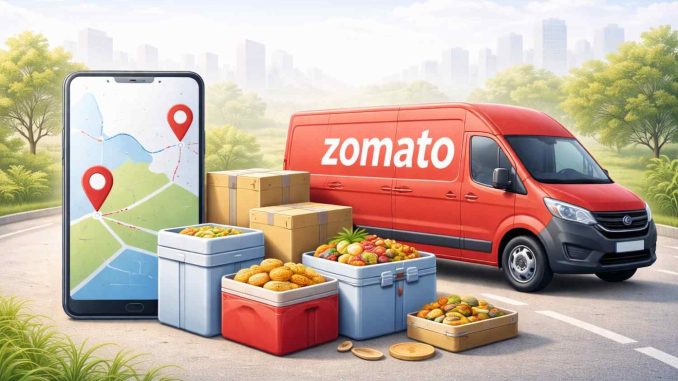
Food delivery major Zomato has acquired a logistics technology startup to expand its intercity food delivery capabilities, marking a strategic move into long-distance delivery services. The acquisition is aimed at improving the company’s supply chain efficiency and enabling faster, more reliable delivery of food across cities.
The move comes as the company looks to diversify its business and tap into the growing demand for intercity food delivery, especially for popular regional dishes and specialty products.
Why This Acquisition Matters
Zomato’s decision to acquire a logistics tech startup signals a major shift in its growth strategy. The company is no longer focusing only on short-distance restaurant deliveries within cities. Instead, it is exploring new opportunities in intercity logistics, where customers can order food from other cities and receive it within hours or the next day. This expansion is important because customer demand is changing, and many users now want access to famous regional dishes, specialty sweets, and branded food items that may not be available locally. Intercity delivery can help meet this demand and open a new revenue stream for the company.
Focus on Intercity Food Delivery
Intercity delivery is emerging as one of the next big opportunities in the foodtech sector. Unlike regular food delivery, which usually happens within a few kilometres, intercity delivery involves transporting food over long distances. This requires advanced logistics technology, temperature-controlled packaging, optimised routing systems, and faster sorting and distribution hubs. By acquiring a logistics startup, Zomato aims to strengthen these capabilities and reduce delivery times between cities.
What the Acquired Startup Brings
The logistics tech startup brings expertise in route optimisation, real-time shipment tracking, warehouse and hub management, last-mile delivery coordination, and data-driven logistics planning. These capabilities are expected to help Zomato build a more efficient intercity delivery network. The startup’s technology can also help reduce operational costs, improve delivery speed, and enhance customer satisfaction.
Strategic Shift Beyond Restaurant Delivery
Zomato has been expanding beyond its core restaurant delivery business in recent years. The company has invested in quick commerce, grocery delivery, B2B food supply, cloud kitchens, and subscription services. The intercity delivery segment is the next step in this diversification strategy. By entering this segment, Zomato can increase order volumes, expand into new product categories, reach customers in smaller cities, and build stronger logistics capabilities.
How Intercity Delivery Works
Intercity food delivery typically follows a hub-based model. In this system, food items are prepared at the source city, packed using temperature-controlled packaging, transported to a central logistics hub, shipped to the destination city, and finally delivered to the customer through local partners. Technology plays a critical role in route planning, delivery scheduling, package tracking, and quality control. The acquired startup’s platform is expected to improve these processes.
Benefits for Customers
The expansion into intercity delivery could bring several benefits for users. Customers may soon be able to order famous dishes from other cities, receive specialty sweets and snacks from regional brands, access premium food products not available locally, and enjoy faster delivery times for long-distance orders. This could significantly change how people order food online.
Impact on Restaurants and Food Brands
The acquisition could also benefit restaurants and food brands. With intercity delivery, restaurants can reach customers in new markets, increase sales without opening new outlets, build national brand recognition, and expand into e-commerce-style food sales. This model is especially useful for regional specialty restaurants, premium dessert brands, packaged food startups, and cloud kitchen operators.
Competitive Landscape
The food delivery industry in India is becoming more competitive, with companies exploring new segments to drive growth. Competitors are investing in quick commerce, grocery delivery, dark stores, logistics infrastructure, and subscription-based services. By moving into intercity logistics, Zomato aims to stay ahead in the evolving foodtech market.
Operational Challenges Ahead
Despite the opportunities, intercity delivery comes with challenges. Maintaining food quality during long-distance transport, managing cold-chain logistics, handling higher operational costs, coordinating between multiple cities and hubs, and ensuring timely deliveries are key issues. The success of this new segment will depend on how efficiently Zomato can manage these challenges.
Investor Perspective
Investors are closely watching how Zomato expands beyond its core food delivery business. New revenue streams such as intercity logistics can help improve margins, increase average order value, and strengthen long-term growth prospects. If the intercity model succeeds, it could become a significant contributor to the company’s revenue.
Short-Term Outlook
In the near term, Zomato is expected to integrate the acquired startup’s technology, launch pilot projects on select routes, partner with popular regional food brands, build intercity logistics hubs, and test customer demand for long-distance orders. The company is likely to roll out the service gradually, starting with high-demand routes.
Long-Term Strategy
Over the long term, Zomato may aim to build a nationwide intercity food delivery network. This could include dedicated logistics corridors, regional sorting centres, partnerships with national food brands, and expansion into non-food categories. Such a network could transform the company into a broader logistics and commerce platform.
What to Watch Next
Market observers will be tracking the launch of intercity delivery pilots, customer adoption rates, cost efficiency of long-distance logistics, impact on overall revenue, and competitive responses from rivals. These factors will determine the success of Zomato’s new strategy.
Bottom Line
Zomato’s acquisition of a logistics tech startup marks a major step toward building intercity food delivery capabilities. The move reflects the company’s strategy to diversify beyond local restaurant delivery and tap into new growth areas.
By strengthening its logistics technology and expanding into long-distance deliveries, Zomato aims to offer customers a wider range of food choices while opening new revenue streams. If executed successfully, the intercity delivery model could become a key part of the company’s long-term growth strategy and reshape how food is ordered and delivered across India.
Last Updated on Friday, February 6, 2026 8:39 pm by Startup Magazine Team
About The Author
