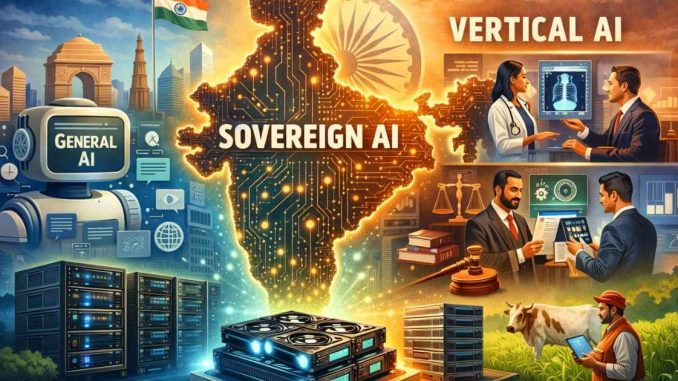
India’s artificial intelligence ecosystem is undergoing a decisive transformation. After years of building applications on top of global, general-purpose large language models, Indian startups are now turning inward—toward sovereign, sector-specific AI systems that are trained on local data, aligned with national regulations, and designed for real-world deployment. This shift from horizontal, one-size-fits-all models to vertical LLMs marks a pivotal moment in India’s technology story, one that blends innovation with strategic autonomy.
For much of the last decade, Indian AI adoption mirrored global trends. Startups integrated widely available LLMs into chatbots, customer service tools, writing assistants, and developer platforms. These models were powerful, fast to deploy, and globally competitive. Yet as adoption deepened, their limitations became increasingly visible. Generic models struggled with Indian languages beyond surface-level translation, misunderstood local legal and cultural contexts, and raised persistent concerns around data sovereignty and regulatory compliance.
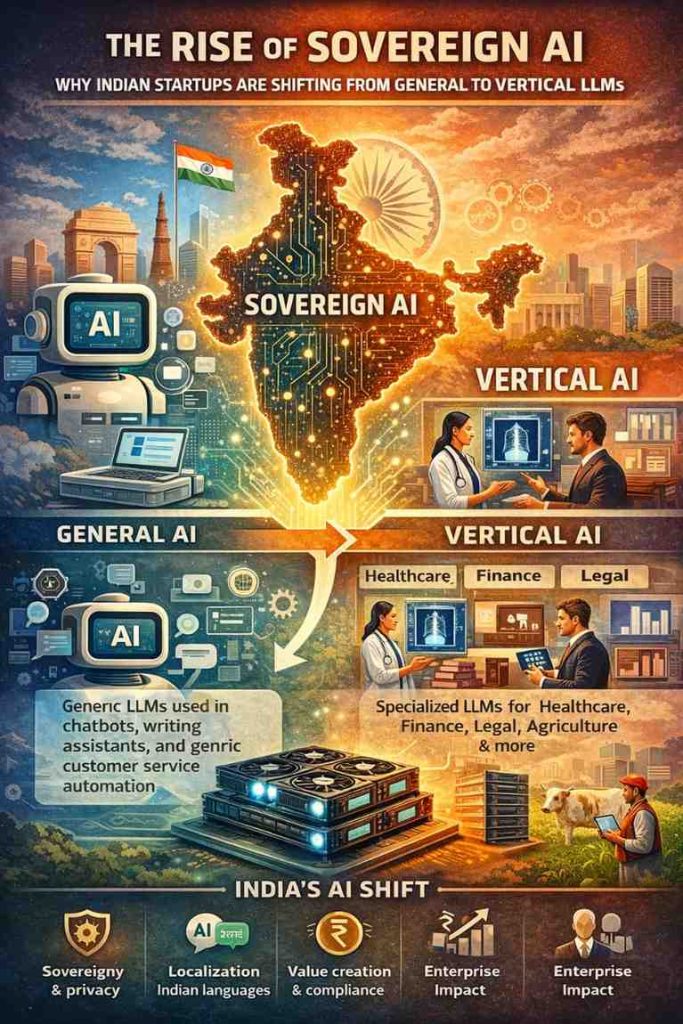
It is against this backdrop that the idea of sovereign AI has gained momentum. Sovereign AI refers to artificial intelligence systems that are developed, hosted, and governed within a country’s own legal and cultural framework. In India, this concept has found resonance not only among policymakers but also among founders and enterprise customers who view AI as critical national infrastructure rather than a plug-and-play commodity.
The government’s policy direction has reinforced this thinking. Recent official assessments have emphasized that India’s competitive edge in AI will come not from replicating frontier models built elsewhere, but from application-led innovation rooted in local needs. This approach has encouraged startups to focus on depth rather than breadth—building models that excel in specific domains such as healthcare, finance, law, agriculture, governance, and education.
At the heart of this transition is India’s linguistic and cultural complexity. With dozens of major languages and countless dialects, the country presents a challenge that global LLMs have only partially addressed. Vertical and sovereign models trained on Indian language datasets are proving far more capable of understanding context, idioms, and intent. For startups serving rural populations, state governments, or regulated industries, this linguistic precision is not a feature but a requirement.
Equally important is the demand from enterprises for accuracy and accountability. Banks, insurers, hospitals, and legal firms cannot afford hallucinations or opaque decision-making from AI systems. Vertical LLMs, trained on curated domain-specific data and aligned with industry workflows, offer more predictable outcomes. They are easier to audit, simpler to integrate with existing systems, and better suited to compliance-heavy environments. As a result, many startups are finding that vertical models deliver faster enterprise adoption and clearer revenue paths than generic AI products.
Data sovereignty has emerged as another powerful catalyst. With India’s data protection regime placing greater emphasis on how and where personal and sensitive data is processed, enterprises are increasingly wary of sending information to overseas servers. Startups that offer India-hosted AI systems, trained on domestically sourced data, are gaining trust in sectors where confidentiality is paramount. Sovereign AI, in this sense, has become a business advantage as much as a policy objective.
The role of the state has been instrumental in accelerating this shift. Large-scale national initiatives aimed at expanding access to high-performance computing and funding foundational AI research have lowered entry barriers for startups that previously lacked the resources to train their own models. By providing shared infrastructure and clear strategic direction, the government has signaled that indigenous AI development is not only encouraged but essential.
However, the move toward sovereign and vertical LLMs is not without challenges. Training and maintaining high-quality models requires sustained access to compute, skilled researchers, and large, reliable datasets—areas where India is still catching up to global leaders. Startups must also balance the need for localization with the economics of scale, ensuring that specialized models remain commercially viable.
Despite these hurdles, confidence within the ecosystem is growing. Many founders believe that verticalization is the only sustainable path forward in a market increasingly saturated with generic AI tools. By focusing on specific problems and local contexts, Indian startups are carving out defensible positions that global players find difficult to replicate.
The broader implications of this shift extend beyond startups alone. Sovereign AI has the potential to reshape how public services are delivered, how small businesses adopt digital tools, and how India positions itself in the global AI race. Rather than competing head-on with multinational tech giants on raw model size, India is betting on relevance, trust, and real-world impact.
As 2026 unfolds, the rise of sovereign and vertical LLMs is redefining the contours of Indian AI. What began as an efficiency-driven adoption of global models is evolving into a confidence-driven pursuit of indigenous intelligence. In doing so, Indian startups are not just building better products; they are laying the foundation for an AI ecosystem that is local in spirit, global in ambition, and sovereign by design.
Also Read : https://startupupdates.in/7-equity-crowdfunding-platforms-in-india-what-founders-should-know-before-raising/
Add startupmagazine.in as preferred source on google – Click Here
Last Updated on Monday, February 2, 2026 2:47 pm by Startup Magazine Team
About The Author
