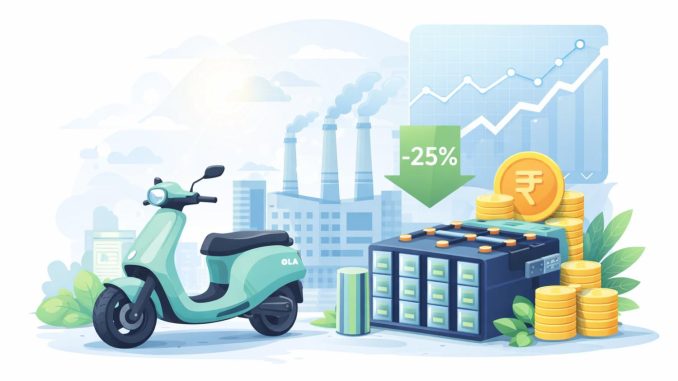
Ola Electric is approaching a key financial milestone, with the company reporting a sharp 25% drop in battery cell manufacturing costs, a development that could accelerate its path to profitability.
The cost reduction comes at a time when the electric two-wheeler market in India is becoming more competitive. Lower battery costs are critical for electric vehicle makers because the battery pack accounts for a large share of the total vehicle price. For Ola Electric, the improvement could strengthen margins, reduce losses, and help the company reach break-even sooner.
Why Battery Cost Reduction Matters
Battery cells are the most expensive component in an electric scooter. In many cases, they make up 30% to 40% of the total vehicle cost.
A 25% reduction in cell manufacturing expenses can significantly improve unit economics. It allows the company to lower production costs, improve profit margins, reduce reliance on discounts, and compete more effectively on price.
For a company aiming to scale rapidly, such cost improvements are a major step toward long-term financial stability.
How Ola Electric Achieved the Cost Drop
The reduction in battery cell costs is largely linked to the company’s focus on local manufacturing and improved production efficiency.
Ola Electric has been investing heavily in its cell manufacturing facilities. By producing battery cells domestically instead of importing them, the company can cut logistics and import costs, avoid currency fluctuations, improve supply chain control, and increase production speed.
Better production processes and higher volumes have also helped reduce the cost per cell.
Impact on Profitability Timeline
Ola Electric has been working toward profitability as it scales production and expands its product lineup.
Lower battery costs directly affect the company’s financial performance. Each scooter sold becomes more profitable as the cost of the battery decreases.
If the current trend continues, the company could reduce operating losses, move closer to break-even, improve investor confidence, and strengthen its position ahead of future capital raises.
Cost reductions at the cell level also provide flexibility in pricing, which is important in a price-sensitive market like India.
India’s Electric Two-Wheeler Market: A Price-Sensitive Segment
India is the world’s largest two-wheeler market, but it is also highly price-conscious. Consumers often compare electric scooters directly with petrol models based on upfront cost.
To drive adoption, EV companies must offer competitive prices without sacrificing margins. Lower battery costs are the most effective way to achieve this balance.
Ola Electric’s cost improvements could help it maintain competitive pricing, offer better features at similar prices, and increase market share.
Local Manufacturing as a Strategic Advantage
The company’s push toward domestic battery production aligns with India’s broader EV policy goals.
Government initiatives such as production-linked incentives and local manufacturing schemes aim to reduce dependence on imports, build a domestic battery ecosystem, and lower EV costs for consumers.
By investing in local cell manufacturing, Ola Electric is positioning itself to benefit from these policy incentives.
Competition in the Electric Two-Wheeler Segment
The Indian electric two-wheeler market is becoming increasingly competitive.
Major players include established two-wheeler manufacturers, traditional auto companies entering the EV space, and new-age EV startups.
As competition grows, cost efficiency becomes a key differentiator. Companies that can produce batteries more cheaply will have a clear advantage.
Ola Electric’s reported 25% cost drop could give it an edge in this environment.
Expansion Plans and New Product Pipeline
Alongside cost improvements, the company has been expanding its product lineup and manufacturing capacity.
The focus areas include new electric scooter variants, upcoming electric motorcycle models, expanded manufacturing output, and technology upgrades.
Higher production volumes can further reduce per-unit costs, creating a positive cycle of scale and efficiency.
Challenges Still Ahead
Despite the progress, the path to profitability is not without challenges.
Key risks include intense price competition as more companies enter the EV space, supply chain uncertainties linked to battery materials, possible policy changes that affect subsidies, and gaps in charging infrastructure and service networks in many regions.
Investor and Market Implications
Cost reductions at the battery level are closely watched by investors because they directly impact margins.
A 25% drop in cell costs signals better operational efficiency, stronger long-term economics, and an improved path to profitability.
This could help the company attract more investor interest, especially as the EV market continues to grow.
What This Means for Consumers
For buyers, lower battery costs could translate into more affordable electric scooters, better range at the same price, and improved product quality.
As manufacturers achieve cost efficiencies, consumers are likely to see more value-for-money EV options.
Outlook: A Turning Point for Ola Electric
The reduction in battery cell costs could mark a turning point for the company’s financial performance.
If cost efficiencies continue and demand remains strong, Ola Electric may move closer to break-even, expand its product range, and strengthen its leadership in the EV market.
The company’s focus on vertical integration and domestic manufacturing could play a key role in its long-term success.
Bottom Line
Ola Electric’s 25% drop in battery cell manufacturing costs brings it closer to profitability at a crucial time for India’s EV market.
Lower battery costs improve margins, support competitive pricing, and strengthen the company’s financial outlook. As the electric two-wheeler market grows, cost efficiency will remain the key factor separating market leaders from the rest.
If the company continues to scale production and control costs, it could achieve profitability sooner than expected and solidify its position in India’s fast-evolving EV ecosystem.
Disclaimer: The information presented in this article is intended for general informational purposes only. While every effort is made to ensure accuracy, completeness, and timeliness, data such as prices, market figures, government notifications, weather updates, holiday announcements, and public advisories are subject to change and may vary based on location and official revisions. Readers are strongly encouraged to verify details from relevant official sources before making financial, investment, career, travel, or personal decisions. This publication does not provide financial, investment, legal, or professional advice and shall not be held liable for any losses, damages, or actions taken in reliance on the information provided.
Last Updated on Monday, February 9, 2026 5:10 pm by Startup Magazine Team
About The Author
