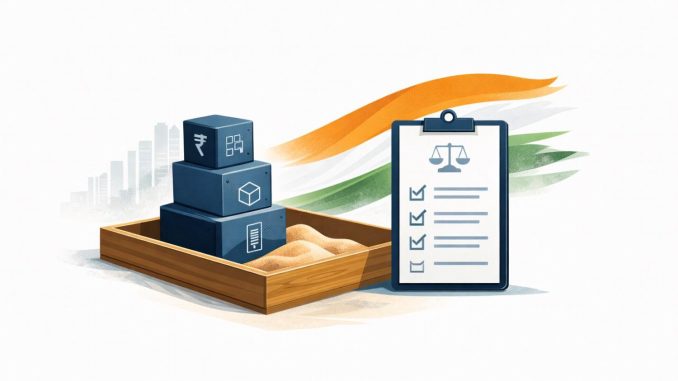
India’s fast-growing fintech sector is increasingly tapping regulatory sandboxes at the International Financial Services Centre (IFSC), as recent reforms make it easier for startups to test new financial products in a controlled environment.
The shift comes at a time when digital payments, cross-border transactions, and financial technology services are expanding rapidly. With supportive policy changes and clearer guidelines, fintech companies are using IFSC sandboxes to experiment with new ideas without facing full-scale regulatory burdens at the early stage.
For India’s financial ecosystem, this trend signals stronger collaboration between regulators and innovators.
What Is an IFSC and Why It Matters
The International Financial Services Centre (IFSC), located at GIFT City in Gujarat, is designed to promote global financial services from India.
It operates under a special regulatory framework that allows financial institutions to serve international markets.
The regulator overseeing IFSC activities is the International Financial Services Centres Authority.
The IFSC framework offers tax incentives and simplified rules to attract global players.
For fintech startups, this ecosystem provides an opportunity to test products that may involve cross-border elements or advanced digital infrastructure.
Understanding Regulatory Sandboxes
A regulatory sandbox is a controlled environment where startups can test innovative financial products with limited risk.
Companies can experiment with new services under the supervision of regulators.
This approach allows authorities to monitor risks while encouraging innovation.
Fintech sandboxes reduce entry barriers for startups.
They help companies refine products before launching them on a large scale.
The model balances innovation and consumer protection.
Why Fintech Startups Are Choosing IFSC Sandboxes
Several fintech startups are now applying to IFSC sandbox programmes.
Recent regulatory reforms have streamlined application processes.
Clearer guidelines and faster approvals have made participation more attractive.
Startups working on digital lending, blockchain-based settlements, and cross-border remittance solutions see strong benefits.
Testing within IFSC allows them to access global markets while remaining under Indian regulatory oversight.
The flexibility offered by IFSC sandboxes is particularly useful for early-stage ventures.
Regulatory Reforms Driving Momentum
In recent years, India has introduced multiple fintech-focused reforms.
The aim is to support innovation while maintaining financial stability.
IFSC-specific reforms have clarified compliance norms and eased operational requirements.
Digital onboarding processes have become simpler.
Data security and consumer protection standards have also been strengthened.
These reforms create a more predictable environment for fintech companies.
Regulatory clarity reduces uncertainty and encourages investment.
GIFT City’s Growing Role in Fintech
GIFT City has emerged as a hub for international banking and fintech services.
Global banks, asset managers, and insurance firms have established operations there.
The fintech sandbox programme adds another layer to its ecosystem.
By combining infrastructure, regulatory support, and international connectivity, GIFT City aims to position India as a global fintech innovation centre.
Startups can access both domestic and global opportunities from a single location.
Cross-Border Innovation and Digital Payments
Many fintech startups focus on cross-border financial solutions.
Remittance services, digital currency models, and trade finance tools require regulatory flexibility.
IFSC sandboxes provide an ideal platform for such testing.
India’s strong digital payment network creates additional opportunities.
Companies exploring international payment corridors can benefit from sandbox frameworks.
Testing products in a supervised environment reduces risk before scaling globally.
Investor Confidence and Funding Prospects
Regulatory backing often increases investor confidence.
When startups operate within recognised sandbox frameworks, funding becomes easier to secure.
Venture capital firms prefer companies that comply with regulatory standards.
Clear regulatory support lowers legal risks.
As fintech adoption rises, investment activity is expected to increase further.
The presence of a sandbox environment adds credibility.
It signals that authorities are supportive of innovation.
Balancing Innovation and Consumer Protection
While encouraging fintech growth, regulators also focus on consumer safety.
Sandboxes include strict monitoring mechanisms.
Limited customer exposure during testing helps prevent large-scale risks.
If issues arise, regulators can intervene early.
This structured testing process ensures that only stable products reach wider markets.
Trust is essential in financial services.
A transparent sandbox system helps maintain that trust.
India’s Position in Global Fintech
India is already recognised as one of the world’s largest digital payment markets.
Unified digital payment systems and fintech adoption have grown rapidly over the past decade.
By strengthening IFSC sandboxes, India signals its ambition to lead in global fintech innovation.
Countries competing in the fintech race are building similar frameworks.
India’s advantage lies in its strong domestic user base and regulatory adaptability.
IFSC sandboxes complement this ecosystem.
Challenges and Considerations
Despite strong momentum, challenges remain.
Fintech startups must ensure data security compliance.
Cybersecurity risks are increasing globally.
Operational costs and infrastructure needs can also be demanding.
Scaling from sandbox testing to full market launch requires additional capital and planning.
Regulators must maintain a balance between flexibility and strict oversight.
Continuous dialogue between startups and authorities will be essential.
Impact on Traditional Financial Institutions
Banks and traditional financial institutions are closely watching sandbox developments.
Many are collaborating with fintech startups to co-develop solutions.
Partnership models allow established institutions to innovate faster.
IFSC sandboxes can act as bridges between new and traditional players.
Joint pilot projects could become more common in the coming years.
This cooperation may accelerate digital transformation across the financial sector.
What This Means for India’s Digital Economy
Fintech innovation supports broader digital growth.
Digital lending platforms improve credit access.
Cross-border payment solutions strengthen trade links.
Blockchain-based systems enhance transparency in settlements.
By promoting sandbox testing, regulators create a foundation for sustainable fintech expansion.
India’s digital economy benefits when innovation is responsibly managed.
Looking Ahead to 2026 and Beyond
Industry experts expect more startups to apply for IFSC sandbox programmes in 2026.
As regulatory reforms mature, participation is likely to rise.
New sectors such as tokenised assets and AI-driven financial services may also enter sandbox trials.
The next few years could define India’s global fintech standing.
Strong infrastructure and regulatory backing are key pillars.
IFSC sandboxes appear to be playing a central role in this transition.
Key Takeaways
Fintech startups are increasingly tapping IFSC sandboxes for controlled product testing.
Regulatory reforms have simplified processes and improved clarity.
GIFT City is emerging as a fintech innovation hub.
Sandbox participation boosts investor confidence and reduces risk.
India aims to strengthen its position in global fintech markets.
As regulatory reforms continue to evolve, IFSC sandboxes are becoming powerful tools for fintech growth. The collaboration between startups and regulators signals a new phase in India’s digital finance journey, where innovation and oversight move forward together.
Disclaimer: The information presented in this article is intended for general informational purposes only. While every effort is made to ensure accuracy, completeness, and timeliness, data such as prices, market figures, government notifications, weather updates, holiday announcements, and public advisories are subject to change and may vary based on location and official revisions. Readers are strongly encouraged to verify details from relevant official sources before making financial, investment, career, travel, or personal decisions. This publication does not provide financial, investment, legal, or professional advice and shall not be held liable for any losses, damages, or actions taken in reliance on the information provided.
Last Updated on Monday, February 23, 2026 11:33 am by Startup Magazine Team
About The Author
