
For nearly a decade, India’s startup ecosystem operated on the assumption that growth could solve almost everything.
Capital was abundant. Valuations climbed rapidly. Venture investors rewarded scale over sustainability. Founders prioritized market capture over profitability. Loss-making businesses became acceptable as long as user growth and revenue expansion continued.
That era has changed dramatically.
Since the global funding slowdown that began in 2022, India’s startup ecosystem has entered a more disciplined phase marked by tighter capital flows, delayed IPOs, valuation corrections, and investor scrutiny around unit economics. But beneath the visible funding winter lies a quieter and potentially more structural problem: the rise of “zombie startups.”
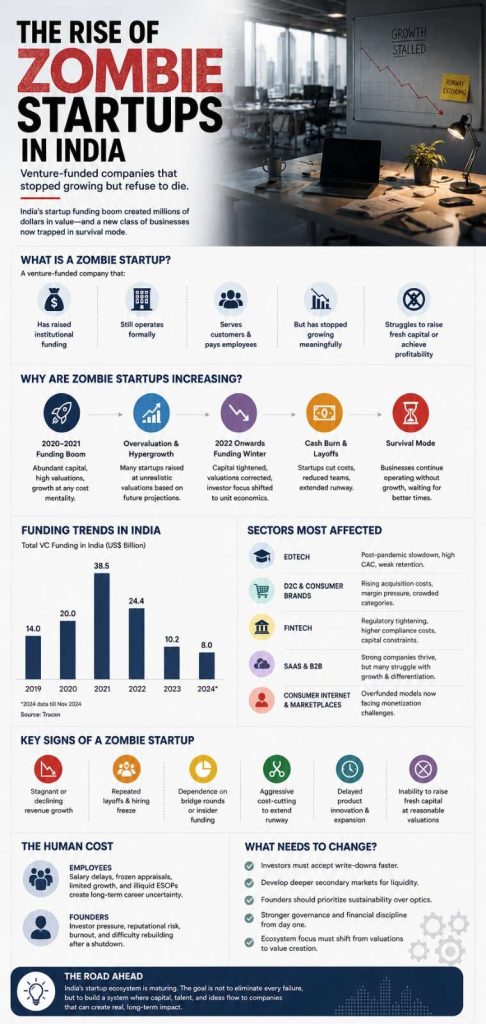
These are venture-funded companies that are no longer growing meaningfully, have limited paths to profitability, struggle to raise fresh capital at attractive valuations, yet continue operating without fully shutting down.
They are not dead businesses. But they are no longer functioning like healthy growth startups either.
Across sectors such as edtech, direct-to-consumer brands, fintech, SaaS, quick commerce adjacencies, and consumer internet, a growing number of Indian startups now exist in survival mode — conserving cash, reducing hiring, avoiding expansion, delaying difficult decisions, and hoping market conditions improve before runway disappears.
The phenomenon is becoming one of the defining post-boom realities of India’s venture capital ecosystem.
What Exactly Is a “Zombie Startup”?
A Company Trapped Between Growth and Collapse
In venture capital terminology, a zombie startup is typically a company that:
- has previously raised institutional funding
- still operates formally
- continues paying employees and serving customers
- has not shut down or filed for bankruptcy
- but has effectively stopped scaling
Unlike fast-growing startups, zombie companies often show:
- stagnant or declining revenue growth
- shrinking market relevance
- repeated layoffs
- frozen hiring
- limited innovation
- inability to raise new capital
- dependence on bridge rounds or insider funding
- aggressive cost-cutting to extend runway
Importantly, many zombie startups are not fraudulent businesses. Some even generate meaningful revenue. The issue is that they no longer justify the venture-scale expectations attached to their earlier valuations.
In many cases, investors hesitate to shut them down because doing so would mean formally recognizing losses on portfolio investments. Founders, meanwhile, often continue operations hoping for acquisition opportunities, market recovery, or strategic pivots.
The result is a growing class of startups existing in prolonged limbo.
Why Zombie Startups Are Increasing in India
1. The 2020–2021 Funding Boom Distorted Market Discipline
India’s startup ecosystem witnessed unprecedented capital inflows during the pandemic-era technology boom.
Low global interest rates pushed investors toward growth assets. Venture capital firms aggressively competed for deals. Startups raised large rounds at extremely high valuations, often based on projected future growth rather than sustainable economics.
This led to several structural distortions:
Growth Became More Important Than Efficiency
Many startups optimized for:
- GMV growth
- customer acquisition
- discount-driven expansion
- vanity metrics
- rapid hiring
Profitability and operational discipline often became secondary concerns.
Valuations Outpaced Business Fundamentals
Some startups raised funding at valuations that assumed years of uninterrupted hypergrowth.
When growth slowed after 2022, many companies found themselves unable to justify those valuations in subsequent funding rounds.
Too Many Similar Startups Received Capital
The funding boom also created overcrowded sectors:
- D2C brands
- quick commerce adjacencies
- B2B marketplaces
- creator economy startups
- crypto-related ventures
- edtech verticals
Not every company could emerge as a category leader.
As funding conditions tightened, weaker businesses remained operational but lost strategic momentum.
The Funding Winter Changed Investor Behavior
Venture Capital Shifted From Growth to Survival Metrics
By 2023 and 2024, investors globally began prioritizing:
- profitability
- cash efficiency
- sustainable margins
- retention quality
- revenue predictability
Indian startups faced:
- down rounds
- delayed fundraising
- lower valuations
- reduced venture deployment
- stricter due diligence
For many companies, fresh funding became significantly harder to secure.
Instead of shutting down immediately, startups began entering survival mode:
- extending runway
- cutting burn
- reducing marketing
- shrinking teams
- pausing expansion plans
This created the conditions for zombie startups to proliferate.
The Sectors Most Vulnerable to Zombie Startup Syndrome
Edtech
India’s edtech sector saw some of the most aggressive pandemic-era expansion.
As offline learning returned, customer acquisition costs increased and growth normalized. Several smaller edtech startups struggled with:
- weak retention
- unsustainable marketing spends
- dependence on discounting
- low engagement quality
Many companies that once raised heavily now operate quietly with smaller teams and reduced ambitions.
The broader sector also faced reputational challenges after governance concerns and financial stress at major players increased investor caution.
D2C and Consumer Brands
The direct-to-consumer boom created hundreds of venture-funded brands competing in crowded categories:
- beauty
- wellness
- fashion
- nutrition
- home products
Many achieved initial traction through performance marketing and marketplace visibility. But rising customer acquisition costs and slowing discretionary spending exposed weak margins.
Several brands today continue operating but struggle to:
- expand offline
- build strong repeat behavior
- improve profitability
- justify premium valuations
The result is a long tail of heavily funded but strategically stagnant businesses.
Fintech
India’s fintech ecosystem remains one of the country’s strongest innovation sectors, but not all funded players succeeded.
Rising regulatory scrutiny from the Reserve Bank of India, changing compliance norms, and tougher capital conditions have created pressure on smaller lending, BNPL, and consumer finance startups.
Many fintech firms now operate conservatively after aggressive expansion plans during the funding boom years.
SaaS and B2B Startups
India’s SaaS ecosystem remains globally respected, especially in enterprise software.
However, not every SaaS startup achieved product-market fit or scalable international growth.
Some venture-funded SaaS firms today generate moderate recurring revenue but lack:
- strong differentiation
- enterprise-scale expansion
- efficient sales economics
These companies often survive through cost discipline but struggle to become breakout businesses.
Why Investors Often Keep Zombie Startups Alive
Writing Off Investments Is Painful
Venture capital economics partly explain why zombie startups survive longer than expected.
If a startup shuts down:
- investors formally recognize losses
- fund performance metrics suffer
- portfolio IRR calculations weaken
- LP scrutiny increases
As a result, investors sometimes prefer:
- bridge funding
- internal rounds
- mergers
- soft landings
- strategic restructuring
rather than immediate shutdowns.
Secondary Markets Remain Weak
India’s startup secondary market is still relatively underdeveloped compared to mature ecosystems like the United States.
That limits liquidity options for:
- early investors
- employees with ESOPs
- founders seeking exits
Without strong acquisition pathways or liquid secondary markets, many startups remain operational even when growth prospects weaken significantly.
The Human Cost of Zombie Startups
Employees Face Career Stagnation
Zombie startups often create hidden workforce challenges.
Employees may experience:
- salary delays
- frozen appraisals
- limited career growth
- reduced innovation culture
- uncertainty around ESOP value
Unlike high-growth startups, zombie companies frequently prioritize survival over talent development.
Many employees remain because:
- hiring markets weakened
- stock options are illiquid
- layoffs elsewhere increased job insecurity
This creates a broader ecosystem productivity issue.
Founders Face Psychological and Strategic Pressure
Founders operating zombie startups often experience:
- investor pressure
- reputational concerns
- emotional burnout
- fear of shutdown stigma
- difficulty raising new ventures later
In India’s startup culture, failure is increasingly accepted rhetorically, but operational shutdowns still carry social and professional consequences.
As a result, some founders continue running weakened businesses longer than economically rational.
The IPO Market Has Also Changed the Equation
Public Markets Want Profitable Growth
The Indian public market environment has become more selective after mixed post-listing performances from several venture-backed technology companies.
Public investors increasingly prioritize:
- profitability visibility
- governance quality
- sustainable margins
- operational discipline
This has reduced the number of realistic IPO candidates among late-stage startups.
Without IPO pathways, many startups lose their most important valuation support mechanism.
That further increases the risk of zombie startup formation.
Are Zombie Startups Entirely Bad for the Ecosystem?
Not Always
Some companies initially viewed as stagnant eventually reinvent themselves successfully.
Periods of slower growth can force:
- operational discipline
- sharper business focus
- sustainable economics
- better governance
Several globally successful companies experienced periods of strategic stagnation before recovering.
In India too, some startups may emerge stronger after restructuring.
However, the broader concern is capital inefficiency.
If too much venture capital remains trapped in non-scaling businesses, ecosystem dynamism slows:
- fresh founders receive less funding
- talent becomes locked in weaker firms
- investor confidence declines
- capital allocation efficiency worsens
Over time, this can reduce overall innovation velocity.
The Rise of Acquihires and Consolidation
Consolidation May Accelerate Across Indian Startups
One likely outcome of the zombie startup era is increased consolidation.
Larger startups and enterprises may increasingly pursue:
- acquihires
- distressed acquisitions
- technology purchases
- brand consolidation
This trend is already visible in parts of:
- SaaS
- fintech
- ecommerce enablement
- D2C commerce infrastructure
As funding remains selective, consolidation could become a more common survival path.
What the Next Phase of Indian Startup Ecosystem Could Look Like
The “Growth at Any Cost” Era Is Likely Over
India’s startup ecosystem is not collapsing. In many ways, it is maturing.
The next decade will likely reward:
- sustainable business models
- capital efficiency
- governance discipline
- durable revenue streams
- realistic valuations
Investors are increasingly cautious about businesses that rely solely on perpetual fundraising.
This shift may reduce headline valuation explosions, but it could create healthier long-term companies.
Fewer Unicorns, More Sustainable Companies
The post-boom environment may produce:
- fewer hypergrowth narratives
- smaller but stronger companies
- founder discipline earlier in the lifecycle
- more realistic expansion strategies
That transition could ultimately improve ecosystem resilience.
But in the near term, India is likely to see a growing population of venture-funded companies stuck between ambition and survival.
The zombie startup era may become one of the defining consequences of India’s first major venture capital correction cycle.
Conclusion
India’s startup ecosystem is entering a more complex phase than the optimism-driven boom years of 2020 and 2021.
The rise of zombie startups reflects deeper structural changes:
- tighter capital markets
- investor caution
- valuation resets
- governance scrutiny
- slower consumer spending
- shifting public market expectations
These companies are not failures in the traditional sense. Many still employ people, serve customers, and generate revenue.
But they represent a growing mismatch between venture capital expectations and operational reality.
The coming years will likely determine which startups successfully reinvent themselves and which remain trapped in prolonged survival mode.
For investors, founders, employees, and policymakers, the challenge is no longer just creating startups.
It is building companies capable of surviving after the funding euphoria disappears.
Last Updated on Wednesday, May 20, 2026 2:27 pm by Startup Magazine Team
About The Author
