
For much of the past decade, software innovation has been measured by how intuitive an interface feels or how quickly a chatbot can respond. But in 2026, the conversation inside India’s fast-growing SaaS ecosystem has moved decisively beyond chat windows and prompt boxes. The defining shift now underway is toward agentic AI — systems designed not just to assist users, but to independently plan, decide, and execute complex tasks in pursuit of business outcomes.
This transition marks a fundamental change in what software is expected to do. Where chatbots respond, agentic systems act. Where traditional SaaS waits for instructions, agentic platforms interpret goals and take initiative. For Indian SaaS companies competing in global markets, this evolution is no longer experimental or optional. It is becoming the core technology strategy shaping products, pricing, and long-term relevance.
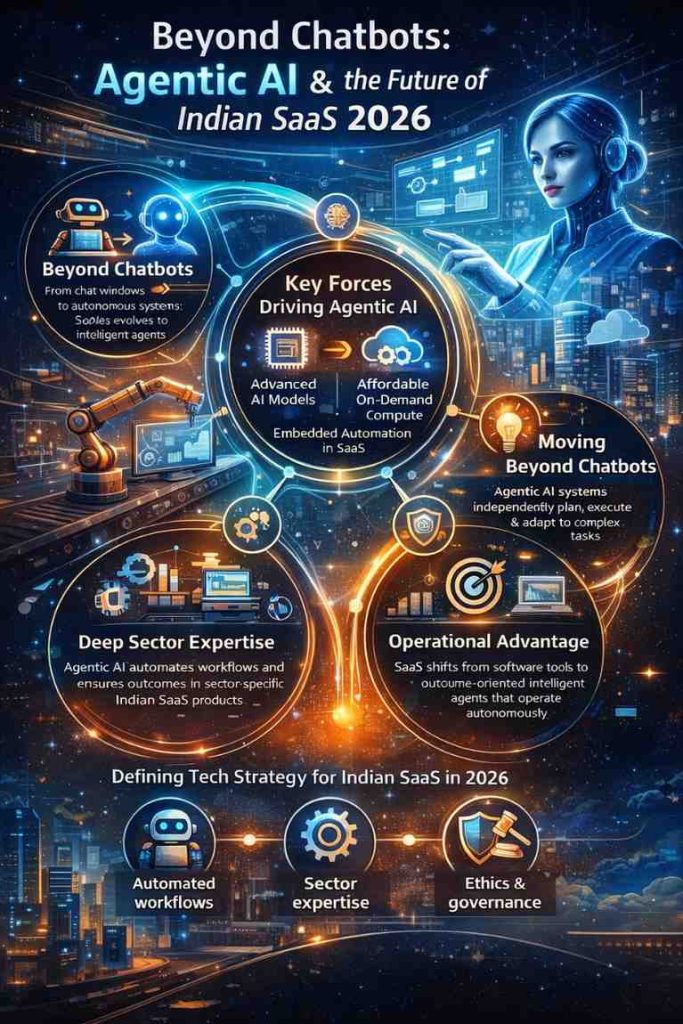
Agentic AI refers to artificial intelligence that operates with a degree of autonomy. These systems can break down objectives, select tools, sequence actions, monitor results, and adjust behavior without constant human input. In practical terms, this means software that does not merely display insights but actively works toward outcomes. A finance platform can identify cash-flow risks and automatically restructure payment cycles. A customer success system can detect churn signals and launch personalized retention actions. A supply-chain application can rebalance inventory in real time as conditions change. The software begins to behave less like a tool and more like a digital operator.
The year 2026 has emerged as a tipping point for this shift. Advances in large language models, reasoning systems, and multimodal AI have made autonomous decision-making far more reliable than in earlier iterations. At the same time, cloud infrastructure costs have stabilized, making continuous AI reasoning economically viable for mid-sized SaaS firms, not just large tech giants. Indian startups, long known for building cost-efficient and scalable software, are now able to embed intelligence deeply into workflows rather than bolt it on as a conversational layer.
For Indian SaaS in particular, agentic AI aligns closely with how the sector has evolved. Over the years, Indian companies have moved away from generic software and toward highly specialized, domain-rich platforms serving finance, HR, healthcare, logistics, retail, and manufacturing. Agentic systems thrive in such environments because they can apply contextual understanding to automate decisions that were previously manual or rule-based. This allows SaaS vendors to promise not just productivity, but performance.
The economic implications are significant. Traditional SaaS business models are built around licenses, seats, and usage metrics. Agentic AI introduces a shift toward outcome-based value. Customers increasingly ask not what features a platform has, but what results it can deliver autonomously. This pushes Indian SaaS firms to rethink pricing, customer success, and even how they define product differentiation. Software that can reduce costs, accelerate revenue, or ensure compliance on its own commands a very different strategic position than software that simply supports human effort.
Yet the rise of agentic AI also brings new challenges. Autonomy introduces complexity, particularly around trust, governance, and accountability. When software can initiate actions across systems, questions arise about oversight, error handling, and ethical boundaries. Indian SaaS leaders are finding that building agentic platforms is as much an organizational challenge as a technical one. It requires new approaches to monitoring AI behavior, defining guardrails, and ensuring that humans remain in control of strategic decisions even as operational tasks are delegated to machines.
There is also a growing awareness that not every company claiming to offer agentic AI is delivering true autonomy. As with previous technology cycles, hype has outpaced reality in some cases. Many products branded as “agents” still rely heavily on scripted workflows or human supervision. Industry insiders acknowledge that a significant number of early agentic initiatives may be abandoned if they fail to demonstrate clear return on investment. The distinction between superficial automation and genuinely autonomous systems is becoming a critical litmus test for credibility in 2026.
Despite these risks, momentum continues to build. Indian engineering talent, combined with strong domain expertise and a culture of building for global clients, places the country in a favorable position. Educational institutions and enterprise training programs are increasingly focusing on agentic system design, AI governance, and human-AI collaboration. This is creating a workforce capable not just of using autonomous tools, but of shaping how they behave in complex business environments.
What ultimately sets agentic AI apart from earlier waves of enterprise technology is its impact on how work itself is structured. As software takes on more responsibility for execution, human roles shift toward supervision, strategy, and judgment. For SaaS vendors, this means their products are no longer passive infrastructure but active participants in business operations. In such a world, the competitive edge lies in trust, reliability, and the ability to deliver consistent outcomes at scale.
By the end of 2026, the divide in Indian SaaS will be clear. On one side will be platforms that added chatbots to existing workflows. On the other will be systems that quietly run those workflows end to end. As customers gravitate toward software that does real work rather than merely facilitating it, agentic AI is emerging not as a feature, but as the defining foundation of the next generation of Indian SaaS.
Add startupmagazine.in as preferred source in google – Click Here
Last Updated on Friday, January 30, 2026 3:16 pm by Startup Magazine Team
About The Author
